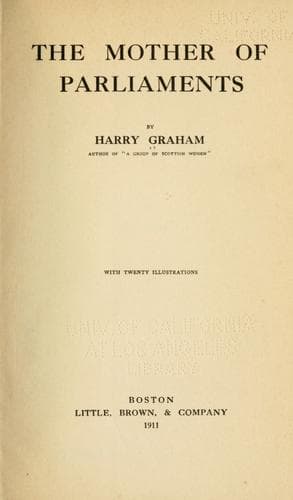
Great Britain. Parliament; Great Britain. Parliament -- History; Representative government and representation
Placed in a position of extraordinary trust, hedged about with the
lofty traditions of his office, weighed down by heavy responsibilities,
engaged in a sedentary occupation during the greater part of the day
or night, a Speaker may well agree with that candid correspondent who,
in congratulating Addington on his elevation to the Chair in 1789,
referred to the Speakership as "one of the most awful posts I
know."[206]
In the long list of those who have so ably guided and controlled the
proceedings of the House of Commons during the last hundred years,
many names stand forth conspicuously--Manners Sutton, Shaw Lefevre,
Denison, Brand, Peel. No Speaker has ever fallen short of the trust
reposed in him, or failed in his duty to the House, and it may
confidently be asserted that so long as the standard of English
political life maintains its present high level, no difficulty will
ever be experienced in providing the Chair with an occupant who shall
fill it, not only worthily, but with distinction.
[206] Pellew's "Life of Sidmouth," vol. i. p. 66.
CHAPTER VIII
THE OPENING OF PARLIAMENT
Parliament, like everything else, must have a beginning. The opening
of a session which is also the commencement of a new Parliament is an
event which tradition invests with all the accompaniments of what
Cobden contemptuously referred to as "barbaric pomp." The inaugural
rites are performed with a stately ceremonial of which Selden himself
would have approved[207]; everything is done to make the pageant as
impressive as possible.
[207] "Ceremony," says Selden, "keeps up all things; 'tis like a penny
glass to a rich spirit, or some excellent water; without it the water
will be spilt, the spirit lost."
The actual business of the opening may be described as extending over
several days, the climax being reached when the sovereign arrives in
person to deliver his speech.
The opening itself is nowadays performed by a Commission issued for
that purpose under the Great Seal. On the day appointed by royal
proclamation for the meeting of a new Parliament, the Houses assemble
in their respective chambers. Before doing so, however, special
precautions have been taken to ensure the safety of our legislators. A
picturesque procession, composed of Yeomen of the Guard in their
striking uniforms, makes its way through the numerous subterranean
vaults of the Palace of Westminster, seeking diligently for the
handiwork of some modern Guy Fawkes. This now familiar search is an
ancient custom kept up more in accordance with popular sentiment than
for any practical reason. The duties of the Beefeaters have no doubt
already been anticipated by the police, but though the fruitlessness
of their quest is now a matter of regular recurrence, they
persistently refuse to be discouraged, and the search is prosecuted
with renewed hopefulness at the commencement of every session.[208]
Public-domain text, read in full here on John Shaqi.
Reviews
Reviews
No reviews yet
Be the first to share your thoughts on this work.
Elsewhere in the archive
Join the Discussion
Join the discussion
Sign in to leave a comment or review.
Sign InorCreate an account