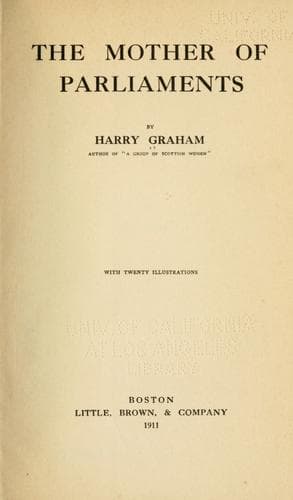
Great Britain. Parliament; Great Britain. Parliament -- History; Representative government and representation
"When it appeareth who is chosen," says Elsynge, "after a good pause
he standeth up, and showeth what abilities are required in the
Speaker, and that there are divers amongst them well furnished with
such qualities, etc., disableth himself and prayeth a new choice to be
made. After which two go unto him in the place where he sits and take
him by the arms, and lead him to the chair."[217] In old days it was
customary for the Speaker-Elect to "disable" himself at great length
and in the humblest possible terms. Christopher Wray, in 1570, spoke
for two hours in this self-deprecatory style. Sergeant Yelverton,
twenty-six years later, explained his unfitness for the post in a
lengthy harangue in which he remarked that if "Demosthenes, being so
learned and eloquent as he was, one whom none surpassed, trembled to
speak before Phocion at Athens, how much more shall I, being unlearned
and unskilful, supply this place of dignity, charge, and trouble to
speak before so many Phocions as here be?"[218] Other Speakers put
forward "a sudden disease," "extreme youth," or some similar
disability as their excuse for escaping from the service of the Chair.
Even as late as the beginning of the eighteenth century Sir Spencer
Compton thought it necessary to declare to the Commons that he had
"neither the memory to retain, the judgment to collect, nor the skill
to guide their debates."[219]
[217] Elsynge's "Parliaments of England," pp. 160 and 161.
[218] D'Ewes' "Journal," p. 549.
[219] Townsend's "History of the House of Commons", vol. i. p. 228.
This excessive humility on the part of a Speaker-Elect has now
disappeared, together with the ridiculous old custom whereby it was
considered correct for him to evince actual physical reluctance to
take the Chair. It was once deemed proper for the newly elected
Speaker to refuse to occupy the exalted throne that awaited him until
his two supporters had seized him by the arms and dragged him like
some unwilling victim to the scaffold. To-day, he "goes quietly," as
the police say; the proposer and seconder lead him gently by the hand,
and he gives his attendants no trouble at all.
After the Speaker has taken the Chair, the mace is laid upon the table
before him, the leaders of either Party offer their congratulations,
and the business of the day is over.
Public-domain text, read in full here on John Shaqi.
Reviews
Reviews
No reviews yet
Be the first to share your thoughts on this work.
Elsewhere in the archive
Join the Discussion
Join the discussion
Sign in to leave a comment or review.
Sign InorCreate an account