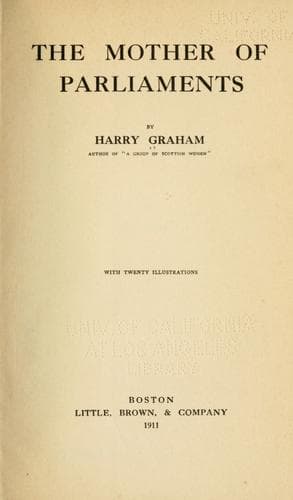
Great Britain. Parliament; Great Britain. Parliament -- History; Representative government and representation
The speeches of Burke, whom Macaulay has described as the greatest man
since Milton, are perhaps the most suitable for perusal of any ever
delivered in Parliament. They read better than they sounded as
delivered; they are rather pamphlets than orations. Burke himself was
deficient in many of the qualities of an orator. His voice was harsh
and his gestures ungainly. He never consulted the prejudices of his
audience. His lapses from good taste were frequent, and among his most
splendid passages may be found occasional coarse and vulgar epithets
and expressions. Yet so great was his eloquence, so marvellous his
oratorical powers, that Byron has included him with Pitt and Fox among
the "wondrous three whose words were sparks of immortality." And the
florid Dr. Parr can scarcely find words sufficiently eulogistic to
sing his praises.[322]
[322] "Burke ... By whose sweetness Athens herself would have been
soothed, with whose amplitude and exuberance she would have been
enraptured, and on whose lips that prolific mother of genius and
science would have adored, confessed, the Goddess of Persuasion."
Prior's "Burke," p. 484.
[Illustration: EDMUND BURKE
FROM AN ENGRAVING BY J. WATSON AFTER THE PAINTING BY SIR J. REYNOLDS]
In the seventeenth century parliamentary attendance and eloquence were
equally poor. Not only did many members speak indifferently; at times
there would be long intervals of silence when members did not speak at
all. "A pause for two or three minutes," ... "The House sat looking at
each other,"[323] are some of the entries in the reports which must
strike the modern mind, accustomed to the present House of Commons, as
peculiar. Steele described the House of his day as being composed of
silent people oppressed by the choice of a great deal to say, and of
eloquent people ignorant that what they said was nothing to the
purpose.[324]
[323] Townsend's "History of the House of Commons," vol. ii. p. 427.
[324] Forster's "Biographical Essays," vol. ii. p. 197.
It was not until the Georgian age that parliamentary oratory reached
its heyday. Then, too, speeches began to lengthen, and by the time
Lord North became Prime Minister it was not unusual for a member to
address the House for two or three hours on end. Lord Brougham once
spoke for six hours on the amendment of the law. Even in Walpole's day
occasional prolixity was not unknown. One Hutcheson, member for
Hastings, when the Septennial Bill of 1716 was under discussion, made
a speech of which the summary fills more than twenty-five pages of the
Parliamentary History.[325] Again, when David Hartley, a notorious
bore, rose to speak one day, Walpole went home, changed his clothes,
rode to Hampstead, returned, changed once more, and came back to
the House to find this tiresome member still upon his legs.[326]
[325] Vol. vii. pp. 339-367.
[326] Pryme's "Recollections," p. 218 n.
Public-domain text, read in full here on John Shaqi.
Reviews
Reviews
No reviews yet
Be the first to share your thoughts on this work.
Elsewhere in the archive
Join the Discussion
Join the discussion
Sign in to leave a comment or review.
Sign InorCreate an account