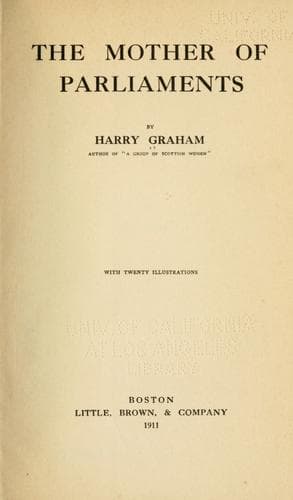
Great Britain. Parliament; Great Britain. Parliament -- History; Representative government and representation
"The House loves good sense and joking, and nothing else," said Sir T.
F. Buxton, in 1819; "and the object of its utter aversion is that
species of eloquence which may be called Philippian."[335]
Sentimentality of any kind is rarely tolerated in Parliament, as may
be seen by the indifference with which Burke's dagger and Lord
Brougham's melodramatic prayer were greeted. When Bright, during the
Crimean War, delivered himself of that famous phrase, "The Angel of
Death has been abroad throughout the land; you may almost hear the
beating of its wings!" it was a question as to how members would take
so sentimental a simile. Had the speaker substituted the word
"flapping" for "beating," as Cobden afterwards observed to him, they
would have roared with laughter.
[335] "Memoirs," p. 89.
The House of Commons, as a writer has remarked, is a body without any
principles or prejudices, except against bores. "He who comes to it
with a good reputation has no better chance than he who besieges it
with a bad one. It rejects all pretensions it has not of itself
justified, and all fame it has not itself conferred."[336] It has,
indeed, always been remarkable for a great reluctance in confirming
reputations for oratory gained elsewhere. Wilkes could sway the
populace with his grandiloquent declamations, but failed ignominiously
in Parliament; Kenealy was refused a hearing. The chastening effect of
the Lower House is notorious, and many a conceited, self-opiniated
individual has found his level after a brief course of subjection to
what Sir James Mackintosh called the "curry-comb of the House of
Commons."[337]
[336] Whitty's "History of the Session" (1852-3), p. 7.
[337] "Journal," vol. i. p. 342.
Besides bores and demagogues, of which it is justly intolerant, the
House of Commons may at one time be said to have numbered lawyers
among its pet aversions. The latter are apt to lecture their
fellow-members as though they were addressing a jury, explaining the
most patent facts, and generally assuming a didactic air which the
House finds it difficult to brook.[338] This perhaps explains the
failure of such distinguished men as Lord Jeffrey and Sir James
Mackintosh, both eloquent lawyers who made little or no mark in
Parliament, and of many other "gentlemen of the long robe," as
Disraeli contemptuously called them.
[338] "Accustomed in their courts to consider every matter of equal
importance," says Barnes, "they adopt the same earnest and stiff
solemnity of manner, whether they are disputing about violated
morality or insulted liberty, or about a petty affray where a hat,
value one shilling, has been torn in a scuffle." "Parliamentary
Sketches," p. 79.
Public-domain text, read in full here on John Shaqi.
Reviews
Reviews
No reviews yet
Be the first to share your thoughts on this work.
Elsewhere in the archive
Join the Discussion
Join the discussion
Sign in to leave a comment or review.
Sign InorCreate an account