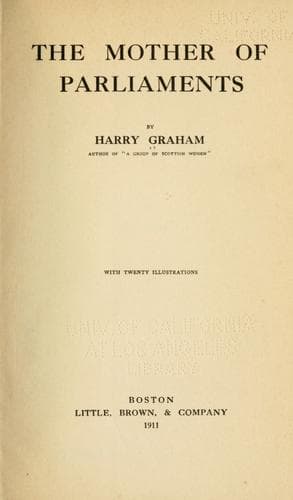
Great Britain. Parliament; Great Britain. Parliament -- History; Representative government and representation
Oratory is perhaps the gift of the gods, but skill in speaking is
undoubtedly an art that can be acquired by practice, if sought
diligently and with patience. Demosthenes gloried in the smell of the
lamp; Cicero learnt every speech by heart. The former would go down to
the seashore on a stormy day, fill his mouth with pebbles, and speak
loudly to the ocean, thus accustoming himself to the murmur of popular
assemblies; the latter on one occasion rehearsed a speech so
diligently that he had little strength left to deliver it on the
following day. The sight of a modern politician sitting on the pier at
Brighton delivering a marine address as intelligibly as a mouthful of
gravel would permit, is one that would only excite feelings of alarm
in the bosoms of his friends; the thought of a Cabinet Minister
fainting before his looking-glass, as the result of an excessive
rehearsal of his peroration, is more pathetic than practical. There
is, however, nothing to prevent a member of Parliament from practising
his elocution upon the trees of the forest, as Grattan did,[350] or
upon the House of Commons itself, and it is thus alone that he will
acquire proficiency in that art in which it is so desirable for the
statesman to excel. "It is absolutely necessary for you to speak in
Parliament," Lord Chesterfield wrote to his long-suffering son. "It
requires only a little human attention and no supernatural
gifts."[351]
[350] Grattan used to walk about the park at Windsor haranguing the
oaks in a loud voice. A passer-by once found him apostrophising an
empty gibbet. "How did you get down?" asked the stranger politely.
O'Flanagan, "Irish Chancellors," vol. ii. p. 416.
[351] Letters, vol. ii. pp. 328-9.
Charles James Fox resolved, when young, to speak at least once every
night in the House. During five whole sessions he held manfully to
this resolution, with the exception of one single evening--an
exception which he afterwards regretted. He thus became the most
brilliant debater that ever lived, "vehement in his elocution, ardent
in his language, prompt in his invention of argument, adroit in its
use."[352] He was, however, too impetuous to be as great an orator as
his rival Pitt, whose majestic eloquence was almost divine,[353] and
offended continually by the tautology of his diction and the constant
repetition of his arguments. The hesitation and lack of grace of his
delivery detracted greatly from the force of his speeches; the
keenness of his sabre, as Walpole said, was blunted by the difficulty
with which he drew it from the scabbard.[354] In a comparison of the
two statesmen, Flood calls Pitt's speeches "didactic declamations,"
and those of Fox "argumentative conversations."[355]
[352] "Lord Colchester's Diary," vol. i. p. 23.
[353] "Pitt spoke like ten thousand angels," wrote Richard Grenville
to George Grenville in November, 1742 ("Grenville Papers," vol. i. p.
19).
[354] "Memoirs," vol. i. p. 490.
Public-domain text, read in full here on John Shaqi.
Reviews
Reviews
No reviews yet
Be the first to share your thoughts on this work.
Elsewhere in the archive
Join the Discussion
Join the discussion
Sign in to leave a comment or review.
Sign InorCreate an account