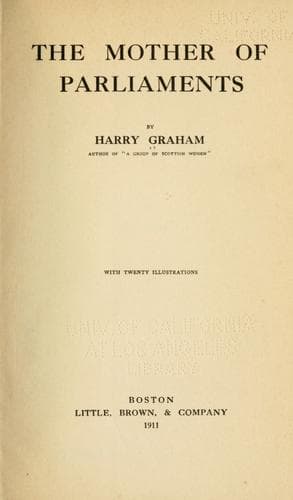
Great Britain. Parliament; Great Britain. Parliament -- History; Representative government and representation
[416] The familiar way in which Pearson addressed members seems to
have been generally condoned on account of his long service. Once when
General Grant, who had boasted that he would march victoriously
through America with three thousand men, asked the door-keeper how
long a certain member would speak, Pearson replied, "As long, General,
if he was allowed, as you would be in marching through and conquering
America!" Pearson's "Political Dictionary," p. 10.
Pearson's treatment of strangers was no less autocratic. He could not
always be corrupted into finding room for them in the galleries unless
he happened to take a fancy to the appearance of the visitors. "If a
face or a manner did not please him," says his biographer, "gold could
not bribe him into civility, much less to the favour of admission. One
stranger might be modest and ingratiating; Pearson, like Thurlow,
would only give him a silent contemptuous stare; another would be
rude; Pearson would laugh at his rudeness, tell him the orator of the
moment, and, perhaps, shove him in, although he had before refused
dozens who were known to him."[417]
[417] Ibid., p. 6.
In the first year of Queen Victoria's reign a suggestion was made that
the public should be admitted without orders of any kind. This idea
was successfully opposed by Lord John Russell, who expressed a fear
that in such circumstances the galleries would be filled with
pickpockets and other objectionable persons.
Prior to 1867 strangers sometimes hired substitutes to keep places for
them in the crowd which thronged St. Stephen's Hall on the morning of
a big debate. These representatives would arrive as early as 2.30
a.m., and, like the messenger boys in the _queue_ outside a modern
theatre, wait patiently until the door was opened in the afternoon.
In 1867 the system of balloting for seats in the Strangers' Gallery
was first instituted. Members had long been in the habit of giving
orders "to bearer," written on the backs of envelopes or any scraps of
paper, which were freely forged and transferred from one visitor to
another. Strangers who were armed with these gallery passes were now
compelled to ballot for precedence, and though on important nights the
number of disappointed applicants was great, visitors gained the
advantage of not being kept waiting for hours on the chance of
obtaining a seat.
This system continued to obtain until the time of the Fenian scares,
in 1885, when, owing to the fact that two strangers admitted to the
Gallery on August 4th proved to be well-known dynamiters, the police
became alarmed for the safety of the House. To prevent the recurrence
of such an unwelcome visit it was ordered that all applications for
admission should be made in writing to the Speaker's secretary. The
signatures of the strangers applying for places could thus be verified
by comparison with their signatures in the Gallery book.
Public-domain text, read in full here on John Shaqi.
Reviews
Reviews
No reviews yet
Be the first to share your thoughts on this work.
Elsewhere in the archive
Join the Discussion
Join the discussion
Sign in to leave a comment or review.
Sign InorCreate an account