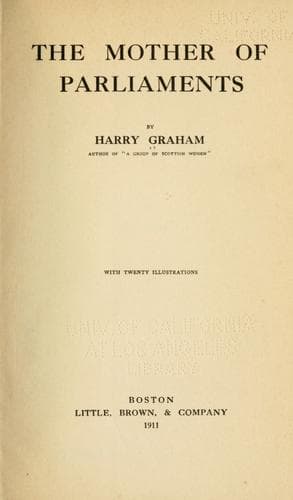
Great Britain. Parliament; Great Britain. Parliament -- History; Representative government and representation
It is not perhaps easy to imagine a modern Premier being placed in a
situation similar to that of either Lord Melbourne or Lord Palmerston.
He must necessarily, to a certain extent, have the whip hand of the
Cabinet. For if several of his colleagues disagree with him on a
question of principle, and resign, he can generally appoint others;
whereas, if he resigns, the whole Ministry crumbles and falls to
pieces.
The Prime Minister nowadays has indeed acquired a position which is
almost that of a dictator. In many ways his power is absolute and his
will autocratic. More especially is this true as regards his dealings
with the Crown. In olden days he was the servant and creature of the
sovereign. He had no voice in the selection of his colleagues; he
acted merely as His Majesty's chief adviser, and, as such, was liable
to instant dismissal. When Pelham resigned in 1746, because he could
no longer agree with the King, he was acting in a fashion that was
then unprecedented. Before that time, a Prime Minister whose views did
not coincide with those of his sovereign, was summarily dismissed.
Many kings had, indeed, been in the habit of themselves undertaking
the duties of Prime Minister--Charles II. delighted in referring to
himself as his own _Premier Ministre_, though he was far too indolent
to perform the work of that official--and merely looked upon their
chief adviser as a convenient channel of communication between
themselves and Parliament.
It was not until the eighteenth century that a Premier of the modern
type came into existence. With the development of the party system,
the gradual growth of the Cabinet's prestige, and the consequent
weakening of the sovereign's prerogatives, the Prime Minister ceased
to be the choice of the Crown, and became the nominee of the nation.
As the leader of the party in office, he acquired the unquestioned
right of selecting his own Ministers. To-day, though the King still
nominally chooses his Prime Minister, little individual freedom is
left to the sovereign, who is guided in his choice by the advice of
the outgoing Premier and his interpretation of the wishes of the
country.
Public-domain text, read in full here on John Shaqi.
Reviews
Reviews
No reviews yet
Be the first to share your thoughts on this work.
Elsewhere in the archive
Join the Discussion
Join the discussion
Sign in to leave a comment or review.
Sign InorCreate an account