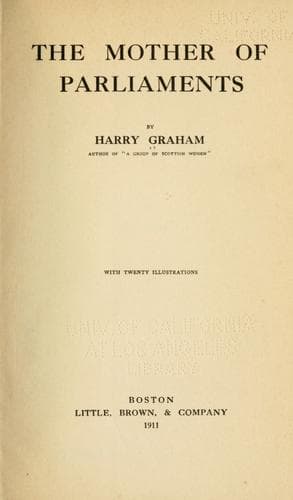
Great Britain. Parliament; Great Britain. Parliament -- History; Representative government and representation
The office of Lord Chancellor developed into one of primary importance
in the time of Edward I., when, from being but a member of the _Aula
Regis_, he became the president of a separate court, a Court of
Equity. Law and Equity have, to a certain extent, been antagonistic
ever since the days when kings were advised by clerics and opposed by
lawyers. In the eyes of the latter Equity was often, as Selden says,
"a roguish thing," untrustworthy, and largely dependent upon the
conscience of individual Chancellors, "and as that is larger or
narrower, so is Equity." But however exaggerated the claim of Equity
to be the "law of God," "the law of nature," or "law of reason,"[157]
it has at least vindicated its position in the statutory enactment
that, where there is a conflict, its rules are to prevail over those
of the Common Law.[158]
[157] "The Fyrste Dyaloge in Englys, between a Doctoure of Dyvynyte
and a Student in the Lawes of England" (1539).
[158] Judicature Act of 1873, section 24.
The conscience of some, at least, of England's early Lord Chancellors
possessed peculiarly plastic qualities. They themselves were not
infrequently ignorant of the principles of law. Occasionally, too,
their conduct and character were such that it is hard to imagine them
as the fount of Equity or justice. Lord Wriothesley, Chancellor in
1544, combined legal incompetence with the most intense religious
bigotry.[159] Chancellor Sir Francis Bacon, philosopher, writer, and
lawyer, whose name is one of the most famous in English history, was
forced to plead guilty to a charge of "corruption and neglect," for
which offence he was deprived of the Great Seal, fined a sum of
£40,000, and imprisoned in the Tower. A hundred years later Lord
Chancellor Macclesfield was impeached and fined for corrupt practices
with regard to the sale of Masterships in Chancery; while the brutal
Jeffreys, stained with the blood of hundreds of innocent and
defenceless persons, was another Lord Chancellor whose presence added
nothing to the prestige of the Woolsack.[160]
[159] His barbarous treatment of the wretched Anne Askew is notorious.
For denying that the sacramental blood and wine lost their material
elements after consecration, Anne was condemned to be tortured, and
the Lord Chancellor with his own hands stretched the rack on which the
unfortunate woman was bound, in the hope of extracting a confession.
It must, however, be admitted that Wriothesley's heart was not
entirely impervious to emotion, for when, as Lord Chancellor, he
announced the death of Henry VIII. in the House of Lords, he could not
refrain from bursting into tears.
[160] He was, however, an able lawyer, and reserved his orgies for
private life. "If my Lord Jefferies exceeded the bounds of temperance
now and then in an evening, it does not follow that he was drunk on
the bench or in council." (Campbell's "Lives," vol. iii. p. 595
_note_.)
Public-domain text, read in full here on John Shaqi.
Reviews
Reviews
No reviews yet
Be the first to share your thoughts on this work.
Elsewhere in the archive
Join the Discussion
Join the discussion
Sign in to leave a comment or review.
Sign InorCreate an account