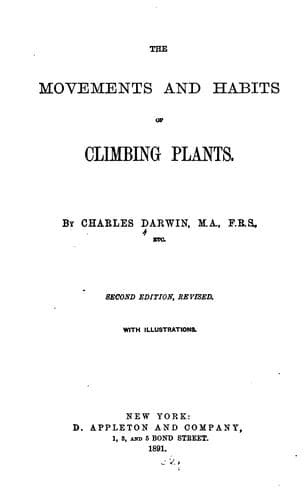
The Movements and Habits of Climbing PlantsDarwin, Charles
Science
The Movements and Habits of Climbing Plants
Darwin, Charles
Climbing plants; Geotropism; Plants; Plants -- Irritability and movements
There is one other interesting point which deserves notice. We have seen
that some tendrils owe their origin to modified leaves, and others to
modified flower-peduncles; so that some are foliar and others axial in
their nature. It might therefore have been expected that they would have
presented some difference in function. This is not the case. On the
contrary, they present the most complete identity in their several
characteristic powers. Tendrils of both kinds spontaneously revolve at
about the same rate. Both, when touched, bend quickly to the touched
side, and afterwards recover themselves and are able to act again. In
both the sensitiveness is either confined to one side or extends all
round the tendril. Both are either attracted or repelled by the light.
The latter property is seen in the foliar tendrils of _Bignonia
capreolata_ and in the axial tendrils of _Ampelopsis_. The tips of the
tendrils in these two plants become, after contact, enlarged into discs,
which are at first adhesive by the secretion of some cement. Tendrils of
both kinds, soon after grasping a support, contract spirally; they then
increase greatly in thickness and strength. When we add to these several
points of identity the fact that the petiole of _Solanum jasminoides_,
after it has clasped a support, assumes one of the most characteristic
features of the axis, namely, a closed ring of woody vessels, we can
hardly avoid asking, whether the difference between foliar and axial
organs can be of so fundamental a nature as is generally supposed? {199}
We have attempted to trace some of the stages in the genesis of climbing
plants. But, during the endless fluctuations of the conditions of life
to which all organic beings have been exposed, it might be expected that
some climbing plants would have lost the habit of climbing. In the cases
given of certain South African plants belonging to great twining
families, which in their native country never twine, but reassume this
habit when cultivated in England, we have a case in point. In the
leaf-climbing _Clematis flammula_, and in the tendril-bearing Vine, we
see no loss in the power of climbing, but only a remnant of the revolving
power which is indispensable to all twiners, and is so common as well as
so advantageous to most climbers. In _Tecoma radicans_, one of the
Bignoniaceæ, we see a last and doubtful trace of the power of revolving.
Public-domain text, read in full here on John Shaqi.
Reviews
Reviews
No reviews yet
Be the first to share your thoughts on this work.
Elsewhere in the archive
Join the Discussion
Join the discussion
Sign in to leave a comment or review.
Sign InorCreate an account