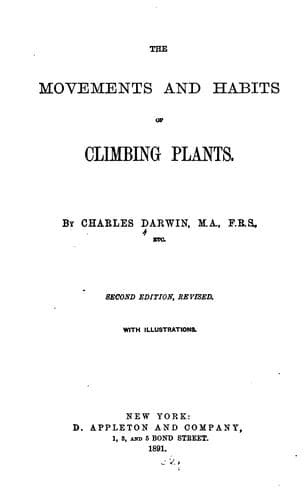
The Movements and Habits of Climbing PlantsDarwin, Charles
Science
The Movements and Habits of Climbing Plants
Darwin, Charles
Climbing plants; Geotropism; Plants; Plants -- Irritability and movements
{18} See Dr. H. de Vries (ibid. p. 324) on this subject.
{19} Comptes Rendus, 1844, tom. xix. p. 295, and Annales des Sc. Nat 3rd
series, Bot., tom. ii. p. 163.
{24} I am much indebted to Dr. Hooker for having sent me many plants
from Kew; and to Mr. Veitch, of the Royal Exotic Nursery, for having
generously given me a collection of fine specimens of climbing plants.
Professor Asa Gray, Prof. Oliver, and Dr. Hooker have afforded me, as on
many previous occasions, much information and many references.
{33} Journal of the Linn. Soc. (Bot.) vol. ix. p. 344. I shall have
occasion often to quote this interesting paper, in which he corrects or
confirms various statements made by me.
{34} I raised nine plants of the hybrid _Loasa Herbertii_, and six of
these also reversed their spire in ascending a support.
{36} In another genus, namely Davilla, belonging to the same family with
Hibbertia, Fritz Müller says (ibid. p. 349) that “the stem twines
indifferently from left to right, or from right to left; and I once saw a
shoot which ascended a tree about five inches in diameter, reverse its
course in the same manner as so frequently occurs with Loasa.”
{37} Fritz Müller states (ibid. p. 349) that he saw on one occasion in
the forests of South Brazil a trunk about five feet in circumference
spirally ascended by a plant, apparently belonging to the Menispermaceæ.
He adds in his letter to me that most of the climbing plants which there
ascend thick trees, are root-climbers; some being tendril-bearers.
{44} Fritz Müller has published some interesting facts and views on the
structure of the wood of climbing plants in ‘Bot. Zeitung,’ 1866, pp. 57,
66.
{68} It appears from A. Kerner’s interesting observations, that the
flower-peduncles of a large number of plants are irritable, and bend when
they are rubbed or shaken: Die Schutzmittel des Pollens, 1873, p. 34.
{71} I have already referred to the case of the twining stem of Cuscuta,
which, according to H. de Vries (ibid. p. 322) is sensitive to a touch
like a tendril.
{75} Dr. Maxwell Masters informs me that in almost all petioles which
are cylindrical, such as those bearing peltate leaves, the woody vessels
form a closed ring; semilunar bands of vessels being confined to petioles
which are channelled along their upper surfaces. In accordance with this
statement, it may be observed that the enlarged and clasped petiole of
the _Solanum_, with its closed ring of woody vessels, has become more
cylindrical than it was in its original unclasped condition.
Public-domain text, read in full here on John Shaqi.
Reviews
Reviews
No reviews yet
Be the first to share your thoughts on this work.
Elsewhere in the archive
Join the Discussion
Join the discussion
Sign in to leave a comment or review.
Sign InorCreate an account