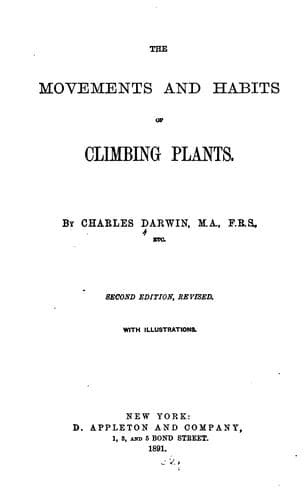
The Movements and Habits of Climbing PlantsDarwin, Charles
Science
The Movements and Habits of Climbing Plants
Darwin, Charles
Climbing plants; Geotropism; Plants; Plants -- Irritability and movements
No. H. M.
1 8 46 A.M.
2 10 0
3 11 0
4 11 37
5 12 7 P.M.
6 12 30
7 1 0
8 1 30
9 1 44
10 2 25
11 3 0
12 3 30
13 3 48
14 4 40
15 5 5
16 5 25
17 5 50
18 6 25
19 7 0
20 7 45
21 8 30
22 9 15
{118} ‘Leçons de Botanique,’ &c., 1841, p. 170.
{127a} I am indebted to Prof. Oliver for information on this head. In
the Bulletin de la Société Botanique de France, 1857, there are numerous
discussions on the nature of the tendrils in this family.
{127b} ‘Gardeners’ Chronicle,’ 1864, p. 721. From the affinity of the
Cucurbitaceæ to the Passifloraceæ, it might be argued that the tendrils
of the former are modified flower-peduncles, as is certainly the case
with those of Passion flowers. Mr. R. Holland (Hardwicke’s
‘Science-Gossip,’ 1865, p. 105) states that “a cucumber grew, a few years
ago in my own garden, where one of the short prickles upon the fruit had
grown out into a long, curled tendril.”
{145} Trans. Phil. Soc. 1812, p. 314.
{146} Dr. M’Nab remarks (Trans. Bot. Soc. Edinburgh, vol xi. p. 292)
that the tendrils of _Amp. Veitchii_ bear small globular discs before
they have came into contact with any object; and I have since observed
the same fact. These discs, however, increase greatly in size, if they
press against and adhere to any surface. The tendrils, therefore, of one
species of _Ampelopsis_ require the stimulus of contact for the first
development of their discs, whilst those of another species do not need
any such stimulus. We have seen an exactly parallel case with two
species of _Bignoniaceæ_.
{152} Fritz Müller remarks (ibid. p. 348) that a related genus,
Serjania, differs from Cardiospermum in bearing only a single tendril;
and that the common peduncle contracts spirally, when, as frequently
happens, the tendril has clasped the plant’s own stem.
{154} Prof. Asa Gray informs me that the tendrils of _P. sicyoides_
revolve even at a quicker rate than those of _P. gracilis_; four
revolutions were completed (the temperature varying from 88 degrees-92
degrees Fahr.) in the following times, 40 m., 45 m., 38½ m., and 46 m.
One half-revolution was performed in 15 m.
Public-domain text, read in full here on John Shaqi.
Reviews
Reviews
No reviews yet
Be the first to share your thoughts on this work.
Elsewhere in the archive
Join the Discussion
Join the discussion
Sign in to leave a comment or review.
Sign InorCreate an account