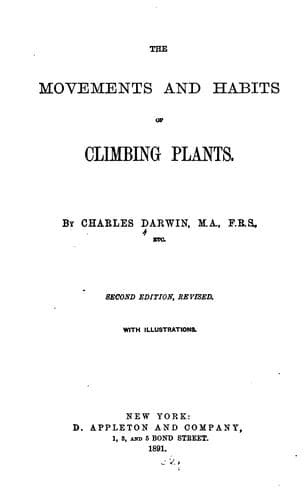
The Movements and Habits of Climbing PlantsDarwin, Charles
Science
The Movements and Habits of Climbing Plants
Darwin, Charles
Climbing plants; Geotropism; Plants; Plants -- Irritability and movements
_Summary on Leaf-climbers_.—Plants belonging to eight families are known
to have clasping petioles, and plants belonging to four families climb by
the tips of their leaves. In all the species observed by me, with one
exception, the young internodes revolve more or less regularly, in some
cases as regularly as those of a twining plant. They revolve at various
rates, in most cases rather rapidly. Some few can ascend by spirally
twining round a support. Differently from most twiners, there is a
strong tendency in the same shoot to revolve first in one and then in an
opposite direction. The object gained by the revolving movement is to
bring the petioles or the tips of the leaves into contact with
surrounding objects; and without this aid the plant would be much less
successful in climbing. With rare exceptions, the petioles are sensitive
only whilst young. They are sensitive on all sides, but in different
degrees in different plants; and in some species of _Clematis_ the
several parts of the same petiole differ much in sensitiveness. The
hooked tips of the leaves of the _Gloriosa_ are sensitive only on their
inner or inferior surfaces. The petioles are sensitive to a touch and to
excessively slight continued pressure, even from a loop of soft thread
weighing only the one-sixteenth of a grain (4.05 mg.); and there is
reason to believe that the rather thick and stiff petioles of _Clematis
flammula_ are sensitive to even much less weight if spread over a wide
surface. The petioles always bend towards the side which is pressed or
touched, at different rates in different species, sometimes within a few
minutes, but generally after a much longer period. After temporary
contact with any object, the petiole continues to bend for a considerable
time; afterwards it slowly becomes straight again, and can then re-act.
A petiole excited by an extremely slight weight sometimes bends a little,
and then becomes accustomed to the stimulus, and either bends no more or
becomes straight again, the weight still remaining suspended. Petioles
which have clasped an object for some little time cannot recover their
original position. After remaining clasped for two or three days, they
generally increase much in thickness either throughout their whole
diameter or on one side alone; they subsequently become stronger and more
woody, sometimes to a wonderful degree; and in some cases they acquire an
internal structure like that of the stem or axis.
Public-domain text, read in full here on John Shaqi.
Reviews
Reviews
No reviews yet
Be the first to share your thoughts on this work.
Join the Discussion
Join the discussion
Sign in to leave a comment or review.
Sign InorCreate an account