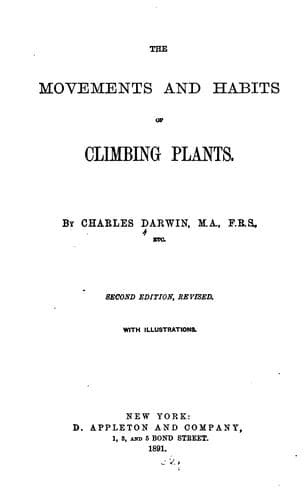
The Movements and Habits of Climbing PlantsDarwin, Charles
Science
The Movements and Habits of Climbing Plants
Darwin, Charles
Climbing plants; Geotropism; Plants; Plants -- Irritability and movements
The young internodes of the _Lophospermum_ as well as the petioles are
sensitive to a touch, and by their combined movement seize an object.
The flower-peduncles of the _Maurandia semperflorens_ revolve
spontaneously and are sensitive to a touch, yet are not used for
climbing. The leaves of at least two, and probably of most, of the
species of _Clematis_, of _Fumaria_ and _Adlumia_, spontaneously curve
from side to side, like the internodes, and are thus better adapted to
seize distant objects. The petioles of the perfect leaves of _Tropæolum
tricolorum_, as well as the tendril-like filaments of the plants whilst
young, ultimately move towards the stem or the supporting stick, which
they then clasp. These petioles and filaments also show some tendency to
contract spirally. The tips of the uncaught leaves of the _Gloriosa_, as
they grow old, contract into a flat spire or helix. These several facts
are interesting in relation to true tendrils.
With leaf climbers, as with twining plants, the first internodes which
rise from the ground do not, at least in the cases observed by me,
spontaneously revolve; nor are the petioles or tips of the first-formed
leaves sensitive. In certain species of _Clematis_, the large size of
the leaves, together with their habit of revolving, and the extreme
sensitiveness of their petioles, appear to render the revolving movement
of the internodes superfluous; and this latter power has consequently
become much enfeebled. In certain species of _Tropæolum_, both the
spontaneous movements of the internodes and the sensitiveness of the
petioles have become much enfeebled, and in one species have been
completely lost.
CHAPTER III.
TENDRIL-BEARERS.
Nature of tendrils—BIGNONIACEÆ, various species of, and their different
modes of climbing—Tendrils which avoid the light and creep into
crevices—Development of adhesive discs—Excellent adaptations for seizing
different kinds of supports.—POLEMONIACEÆ—_Cobæa scandens_ much branched
and hooked tendrils, their manner of
action—LEGUMINOSÆ—COMPOSITÆ—SMILACEÆ—_Smilax aspera_, its inefficient
tendrils—FUMARIACEÆ—_Corydalis claviculata_, its state intermediate
between that of a leaf-climber and a tendril-bearer.
Public-domain text, read in full here on John Shaqi.
Reviews
Reviews
No reviews yet
Be the first to share your thoughts on this work.
Join the Discussion
Join the discussion
Sign in to leave a comment or review.
Sign InorCreate an account