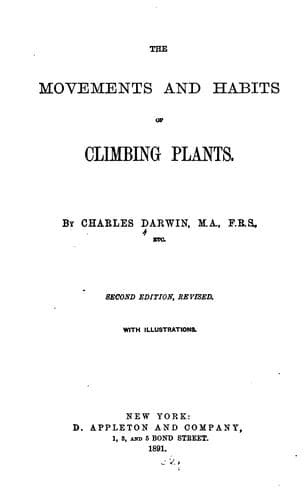
The Movements and Habits of Climbing PlantsDarwin, Charles
Science
The Movements and Habits of Climbing Plants
Darwin, Charles
Climbing plants; Geotropism; Plants; Plants -- Irritability and movements
The tendrils, on the other hand, when the internodes and petioles are
secured, describe irregular spires or regular ellipses, exactly like
those made by the internodes. A young tendril, only 1⅛ of an inch in
length, revolved. Dutrochet has shown that when a plant is placed in a
room, so that the light enters laterally, the internodes travel much
quicker to the light than from it: on the other hand, he asserts that the
tendril itself moves from the light towards the dark side of the room.
With due deference to this great observer, I think he was mistaken, owing
to his not having secured the internodes. I took a young plant with
highly sensitive tendrils, and tied the petiole so that the tendril alone
could move; it completed a perfect ellipse in 1 hr. 30 m.; I then turned
the plant partly round, but this made no change in the direction of the
succeeding ellipse. The next day I watched a plant similarly secured
until the tendril (which was highly sensitive) made an ellipse in a line
exactly to and from the light; the movement was so great that the tendril
at the two ends of its elliptical course bent itself a little beneath the
horizon, thus travelling more than 180 degrees; but the curvature was
fully as great towards the light as towards the dark side of the room. I
believe Dutrochet was misled by not having secured the internodes, and by
having observed a plant of which the internodes and tendrils no longer
curved in harmony together, owing to inequality of age.
Dutrochet made no observations on the sensitiveness of the tendrils.
These, whilst young and about an inch in length with the leaflets on the
petiole only partially expanded, are highly sensitive; a single light
touch with a twig on the inferior or concave surface near the tip caused
them to bend quickly, as did occasionally a loop of thread weighing
one-seventh of a grain (9.25 mg.). The upper or convex surface is barely
or not at all sensitive. Tendrils, after bending from a touch,
straighten themselves in about two hours, and are then ready to act
again. As soon as they begin to grow old, the extremities of their two
or three pairs of branches become hooked, and they then appear to form an
excellent grappling instrument; but this is not the case. For at this
period they have generally quite lost their sensitiveness; and when
hooked on to twigs, some were not at all affected, and others required
from 18 hrs. to 24 hrs. before clasping such twigs; nevertheless, they
were able to utilise the last vestige of irritability owing to their
extremities being hooked. Ultimately the lateral branches contract
spirally, but not the middle or main stem.
Public-domain text, read in full here on John Shaqi.
Reviews
Reviews
No reviews yet
Be the first to share your thoughts on this work.
Elsewhere in the archive
Join the Discussion
Join the discussion
Sign in to leave a comment or review.
Sign InorCreate an account