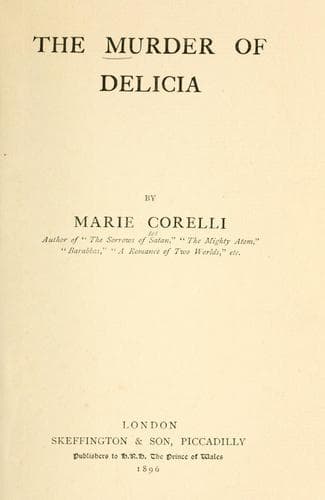
Detective and mystery stories; English fiction -- 19th century
‘Lord Carlyon, to rant and scream is not my _métier_,’ she said. ‘I
leave that to the poor “Marina,” when you have dosed her with too much
champagne. There is no need to go over the cause of our present
conflict; what I have to say can be said in very few words. Your
“unsexed” wife, who has had the honour of maintaining you ever since
your union with her, by the ungrudging labour of her brain and hand, has
sufficient sense of justice and self-respect to continue no longer in
that eminently unpractical mode of action. We must for the future live
apart; for I cannot consent to share your attentions with one stage
_artiste_ or any number of stage _artistes_. I do not choose to pay for
their jewels; and your generous offer to settle Lady Brancewith’s bills
for her does not meet with my consent or approval.’
Her face grew colder and more contemptuous as she continued,—
‘Your estimate of what is called a “clever” woman is as low as that of
most men. I do not especially blame you for being like the rest of your
sex in that one particular. Women who will not become as dirt under a
man’s foot, to be trodden on first, then kicked aside, are generally
termed “unsexed,” because they will not lower themselves to the man’s
brute level. Nothing is more unnatural from a man’s point of view than
that a woman should have brains,—and with those brains make money and
position often superior to his, and at any rate manage to be independent
of him. What men prefer is that their wives should be the slaves of
their humour, and receive a five-pound note with deep thankfulness
whenever they can get it, shutting their eyes to the fact that people
like “Marina” get twenty pounds to their five from the same quarter.
But you,—you have had nothing to complain of in the way of a pecuniary
position, though I, as bread-winner, might readily have comported myself
after approved masculine examples and given you five pounds where I
spent twenty on myself and my own pleasure. But I did nothing of this
sort; on the contrary, I have trusted you with half of everything I
earned, believing you to be honest; believing that, of all men in the
world, you would never cheat, defraud, or otherwise deceive me. And not
only have you made a mock of me in society, but you have even helped to
vilify my name. For it was distinctly your business to chastise the
writer of that lying paragraph in the paper; but you left me to be
defended by one who shares with me the drawback of being a “public
character,” and with whom I have no connection whatever beyond that of
friendship, as you perfectly well know. Why, I have heard of men,
well-born, too, and of considerable social attainment, who have been
willing enough to fight for the so-called “honour” of an admitted
_demi-mondaine_; but for an honest woman and faithful wife, who is there
in these days that will stir a finger to defend her from slander! Very
few; least of all her husband! To such a height has nineteenth-century
Public-domain text, read in full here on John Shaqi.
Reviews
Reviews
No reviews yet
Be the first to share your thoughts on this work.
Elsewhere in the archive
Join the Discussion
Join the discussion
Sign in to leave a comment or review.
Sign InorCreate an account