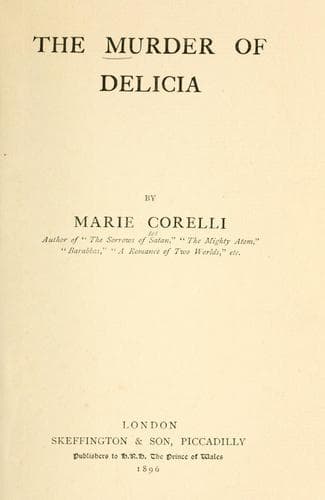
Detective and mystery stories; English fiction -- 19th century
Mrs Cavendish sighed and smiled. She had had her turn of social life
long years ago, and had got thoroughly tired of its vapid folly and
hypocrisy, but she had managed to find a good husband, and for that was
daily and hourly thankful. The great sorrow of her life was that she
had not been blessed with children, and it was partly this shadow, on
her otherwise happy and tranquil lot, which made her attachment to
Delicia peculiarly tender. Had that brilliant and popular novelist been
her own daughter, she could not have loved her more, and there was an
uneasy sense of foreboding in her good, motherly soul that night which
kept her awake for a long time, thinking and wondering as to what would
happen if certain rumours concerning Lord Carlyon turned out to be true.
She knew Delicia’s character better than most people; she was aware that
beneath that apparently pliant, sweet nature, there was a resolute
spirit, strong as iron, firm as adamant—a spirit which would assuredly
make for right and justice whenever and however tested and tried; but
she could not foresee in what way Delicia would resent a wrong,
supposing she had cause for such resentment. She looked slight as a
reed and delicate as a lily; but appearances are deceptive; and nothing
can well be more foolish than to estimate a person’s mental capacity by
his or her outward bearing. A rapier is a thin, light weapon, but it
can nevertheless kill; a nightingale has nothing to boast of in its
plumage, but its singing surpasses that of all the other birds in
creation. Only the purely barbaric mind judges things or individuals by
surface appearances. Anyone who had attempted to fathom Delicia’s
character by her looks would have formed a very erroneous estimate of
her, for, to the casual observer, she was merely a pretty, lovable
woman, with a sunny smile and a graceful bearing, and that was all. No
one would have given her credit for such virtues as strong
self-restraint, courage, determination, and absolute indifference to
opinions; yet all these she had in no small degree, combined with an
extraordinary directness and swiftness of action which is commendable
enough when it distinguishes a man, but is somewhat astonishing when
discovered in the naturally capricious composition of a woman. This
direct method of conduct impelled her now; for while Mrs Cavendish lay
awake worrying about her, she herself, on returning home that evening,
had fully made up her mind as to what she meant to do. Going into her
study, she sat down and wrote a letter to her husband, in which, with
concise and uncomplaining brevity, she told him all. She concluded her
epistle thus:—
Public-domain text, read in full here on John Shaqi.
Reviews
Reviews
No reviews yet
Be the first to share your thoughts on this work.
Elsewhere in the archive
Join the Discussion
Join the discussion
Sign in to leave a comment or review.
Sign InorCreate an account