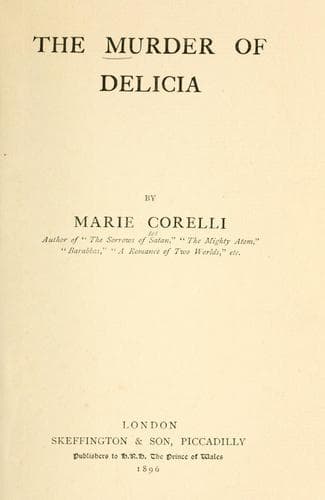
Detective and mystery stories; English fiction -- 19th century
‘No, you are not quite bad-looking, Delicia, but you have one horrible
defect—you have got what is called an “expressive” face. That is a
mistake! You should not have any expression; it is “bad form” to look
interested, surprised, or indignant. A beautiful nullity is what men
like—a nullity of face combined with a nullity of brain. You should
paint and powder and blacken your eyelashes, and you should also be
ready to show your ankles, “by accident,” if necessary. The men would
find you charming then, Delicia; they would say you had “go” in you; but
to be simply a student, with ideas of your own about the world in
general, and to write down these ideas in books, which give you a fame
and position equal to the fame and position of a man,—this makes you a
bore in their eyes, Delicia!—an unmitigated nuisance, and they wish you
were well out of their way! If you could only have been a “Living
Picture” at the Palace Theatre, or turned out your arms and twiddled
your toes in front of the footlights with as few garments on as
possible, you would have been voted “clever,” Delicia! But being a
successful rival with men in the struggle for fame, they vent their
spite by calling you a fool. And you are a fool, my dear, to have ever
married one of them!’
Smiling at herself disdainfully, she gathered up her fan and gloves, and
descended to her carriage. No message had come from Carlyon to say
whether or no he meant to be present at the party that evening; but his
wife had attained to such an appreciable height of cool self-control,
that she now viewed the matter with complete indifference. Arrived at
Lord Dexter’s stately house in Park Lane, she went to the ladies’ room
to throw off her wraps, and there found, all alone, and standing well in
front of the long mirror, so as to completely block the view for anyone
else, a brilliant-looking, painted personage in a pale-green costume,
glittering with silver, who glanced up as she entered and surveyed her
pearl embroideries with greedy admiration.
‘What an awfully sweet gown!’ she burst out frankly. ‘I always say what
I think, though I am told it is rude. It’s awfully sweet! I should
like just such a one to dance in!’
Delicia looked at her in a haughty silence. The other woman laughed.
‘I suppose you think it pretty cool of me making remarks on your
clothes,’ she said; ‘but I’m a “celebrity,” you see, and I always say
what I like and do what I like. I’m Violet de Gascon;—_you_ know!—the
“Marina.”’
Frozen into a rigid state of calm, Delicia loosened her lace wrappings
with chilly fingers, and allowed the servant in attendance to take them
from her.
‘Are you?’ she then said, slowly and bitterly, ‘I congratulate you! As
you have given me your name, I may as well give you mine. I am Lady
Carlyon.’
Public-domain text, read in full here on John Shaqi.
Reviews
Reviews
No reviews yet
Be the first to share your thoughts on this work.
Elsewhere in the archive
Join the Discussion
Join the discussion
Sign in to leave a comment or review.
Sign InorCreate an account