“Oh, he did, did he?” replied Whyland. “And what do you make of it,
may I ask?”
Mr. Ludgrove shrugged his shoulders. “I know no more than what the
paper contains,” he said. “It looks to me like a practical joke. I
shouldn’t wonder if some idiot derives amusement from sending these
counters broadcast. I daresay he gets the names of people to send them
to from the telephone directory.”
“Practical joke? H’m,” said Whyland. “Mind, I’m not denying that a lot
of fools do send out these counters to their friends. The Yard has had
dozens of cases reported to them. I always said that would happen as
soon as people heard about them. But in this case I have seen the
envelope in which the counter was sent. It was typed on the same
machine as the others, and it was posted in this district, exactly as
the others were. Your practical joker has followed his original model
pretty closely, don’t you think?”
The ardent seekers after sensation redoubled their eagerness for news
of the next counter. Although opinion on the whole followed Mr.
Ludgrove in attributing the counter sent to Mr. Goodwin to some
irresponsible practical joker, the fact that death had undoubtedly
followed its receipt caused many to shake their heads knowingly. If
Mr. Martin’s death had been due to suicide, and Mr. Goodwin’s to a
practical joke, how would the original sender of the counters number
his next one? It was not to be supposed that he would claim credit for
these spurious imitations of his work. If the next number were to be
VI, public opinion was quite prepared to credit him with having
compassed the last two deaths. But most people anticipated that it
would bear the number IV.
The fact that such discussion was possible showed clearly that the
theory of the existence of some mysterious assassin had captured the
popular imagination. There was really no reason why any murderer
should not send a numbered counter to his prospective victim, but
people argued, quite correctly, that murders were far more often the
result of sudden impulse than of deliberate intention. It was for this
reason that the “counter deaths” as they were sometimes called,
attracted so much attention. Yet the weeks drew into months, and the
cold winds of spring took the place of the misty drizzle of winter,
without any news of another numbered counter being received. The
arm-chair criminologists gave it as their opinion that the last had
been heard of them, that the mysterious criminal had either fulfilled
his vengeance or had died unrecognized in some lunatic asylum. The
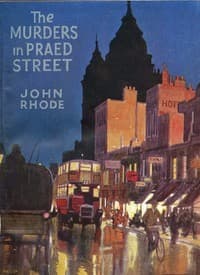
murders in Praed Street were added to the long list of undiscovered
crimes, and slowly they began to be forgotten.
Public-domain text, read in full here on John Shaqi.
Reviews
Reviews
No reviews yet
Be the first to share your thoughts on this work.
Elsewhere in the archive
Join the Discussion
Join the discussion
Sign in to leave a comment or review.
Sign InorCreate an account