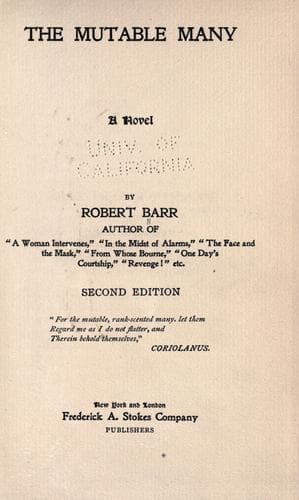
Factories -- Fiction; London (England) -- Fiction; Love stories; Strikes and lockouts -- Fiction
“It shall be done. The men will go in for it when they hear ye’ve got
the sack. They still feel sore over the defeat, as if it wasn’t all
their own fault; and now their fear of Sartwell’s packing some o’ them
off is over, they’ll like to show a little independence by electing you,
to prove to the manager that they’re not afraid, which they are. Ah’ll
have to convince them that Sartwell won’t strike back or take your
appointment as a defiance.”
“But perhaps he will.”
“Not him. He was as sick o’ the strike as any one. No. He’ll shrug his
shoulders, but he’ll say nothing. Ah’m certain that if Gibbons had
had the sense to go to the masters at the first, he would have broken
Sartwell long since. An’ that was what Sartwell was afraid of, Ah’ll
be bound. His greatest stroke was getting Monkton and Hope out of the
country. It was your visit to Hope did that. Sartwell saw ye’d put your
finger on the weak spot; an’ Ah’ll warrant, if we knew the ins and outs
of it, Sartwell threatened ta chook up the whole business if they didn’t
leave, and they left. Ah! he’s a man as can fight, is Sartwell.”
They had reached the court shortly before their conversation had arrived
at this point, and Marsten sat down with his host. The room was barer
than such places usually are, for every pawnable or salable thing had
been removed from time to time as the siege went on. The empty space
where the old harmonium had stood made the room seem larger than it
really was.
“Yes,” said Braunt with a sigh, noticing Marsten’s eye wandering to the
vacant spot, “it was the last thing that went before Jessie died. We
pawned it, thinking we’d get it back again, but Ah’ll never take it
back. Ah’m glad it’s gone. Ah couldn’t bear to look at it. But let’s not
talk of what’s away, but o’ what’s here. Ye’re still thinkin’ ye can do
somethin’ for the workin’ man by organization?”
“I’m sure of it.”
Braunt shook his head.
“Ye won’t, my lad, but Ah’ll do my best to get ye the chance ta try.
Just look at what has happened. They let Gibbons go without a word: he
was a fool, perhaps, but he worked hard for them, an’ they don’t even
say thankee. An’ they’ll do the same wi’ ye. They’ll do the same wi’ any
one.”
“It all depends on how they are led. When men are foolishly led, they
soon find it out and lose confidence. Think what a man like Napoleon
might have accomplished if he had led workingmen instead of soldiers,
and had turned his talents to bettering his fellow-men instead of
butchering them!”
“Napoleon could have done nothin’. He could have done nothin’ wi’
soldiers, even, if it had not been for one power which ye can never
have.”
“What is that?”
“The power o’ orderin’ a man out o’ the ranks, an’ havin’ him shot. If
Ah’d that power Ah’d lead the men maself, an’ get them anythin’ they
wanted. The State will let you slowly starve a hundred men to death and
never interfere, but if ye shot even Gibbons there’d be a row about it.
An’ yet we think we’re civilized! Ah say we’re savages.”
Public-domain text, read in full here on John Shaqi.
Reviews
Reviews
No reviews yet
Be the first to share your thoughts on this work.
Elsewhere in the archive
Join the Discussion
Join the discussion
Sign in to leave a comment or review.
Sign InorCreate an account