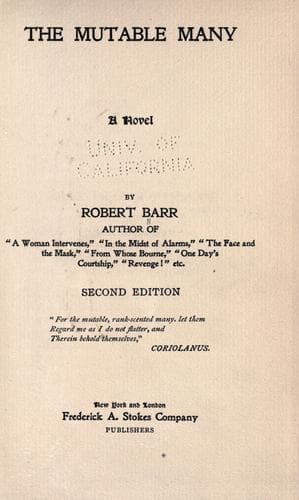
Factories -- Fiction; London (England) -- Fiction; Love stories; Strikes and lockouts -- Fiction
In no instance was the evidence of Sartwell’s silent wrath more manifest
than in the cases of Braunt and Scimmins. The two men had been equal in
position when the strike began, although Scimmins received rather more
money than Braunt. Now Braunt was made superintendent of the upper
floor, where most of the employees were women and boys, while Scimmins
was given the work which one of the boys who did not return at the end
of the strike had done. Scimmins had the double humiliation of being
under the none too gentle orders of the big Yorkshireman whom he had
flouted during the strike, and also of having to accept little more than
boy’s wages. He cursed Sartwell loud and often; but the manager was a
man who paid little heed to the curses of others, and Scimmins was not
in a position to refuse the small pay he received.
Sartwell had at last arranged the interior economy of the factory to his
liking, and was just promising himself a few days free from worry down
at Eastbourne, when a most unlooked-for disaster overturned all his
plans. Shortly before the dinner hour he was coming down the stairs from
the upper floor, when a shriek, which seemed to be the combined voices
of those he had left a moment before, paralyzed him where he stood. The
first thought that flashed through his mind was that Braunt had gone
suddenly mad, and, perhaps, killed some one; for the manager had
noticed, since Braunt’s promotion, that he sometimes spoke wildly, while
now and again there was a dangerous maniacal gleam in his eye which
betokened latent insanity. Before he could turn around, two dishevelled,
screaming women passed him.
“What’s wrong?” he shouted after them.
“Fire!” they shrieked back at him as they fled.
As Sartwell bounded up the stairs he met no more coming down. He heard
outside in the yard a man’s deep voice hoarsely shouting, “Fire! Fire!”
The manager’s heart sank as he thought of the numbers on the upper
floor, the narrow stairway, and the single exit. The other floors were
reasonably safe, with broad stairways and wide doors; but the upper
floor, which formerly had but few occupants, had long been a source
of anxiety to him, fearing, as he did, just such a catastrophe as now
seemed imminent. The remedying of this had often been agreed upon by
both the owners and himself, and was among the good intentions which
were at various times postponed to a more convenient season,--and now
the cry of “Fire!” was ringing in his ears, and the narrow stair was the
only means of escape!
Public-domain text, read in full here on John Shaqi.
Reviews
Reviews
No reviews yet
Be the first to share your thoughts on this work.
Elsewhere in the archive
Join the Discussion
Join the discussion
Sign in to leave a comment or review.
Sign InorCreate an account