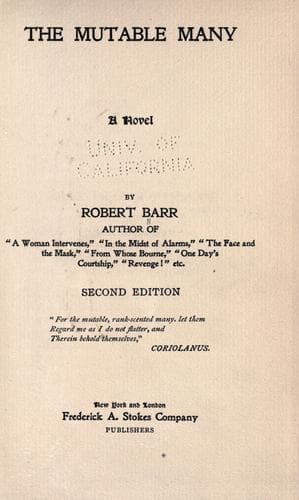
Factories -- Fiction; London (England) -- Fiction; Love stories; Strikes and lockouts -- Fiction
Marsten, addressing them, said that his whole object in taking the
secretaryship was to bring about an amalgamation of labour which would
make the results of future strikes a certainty. All the rights mankind
possessed had been won by battle; but the battles must be successful,
and success was only possible when there was no dissension in the camp.
He frankly stated that he had learned there was some dissatisfaction
because he got more money than was earned by many who laboured in the
ranks, and he had made an estimate of how little he could live upon,
which was less than the poorest paid employee of the works received.
He was willing to accept this sum, and would devote his whole time and
energy to the cause of labour as faithfully as if he were given ten
times the amount.
Gibbons, who had at last found employment in the neighbourhood, here
rose to his feet. He said he thought the office of secretary could be
still more economically filled. He was sure they had men among them, now
in employ, who would act as secretary without salary from the Union, and
perform all the duties quite acceptably to the majority of the men.
“Why didn’t you propose that when you were secretary yourself, Gibbons?”
asked one of the audience, at which there was some laughter.
“I did not do so because I was at that time out of work,” replied
Gibbons, warming to his theme. “I don’t wish to say a word against the
present secretary, but I would like to ask him a question or two. He
seemed once of opinion that Sartwell was a very shrewd, far-seeing man.
I would like to know, Mr. Marsten, if you are still of that opinion?”
“I am,” answered Marsten.
“Then can you explain to the meeting why Sartwell has taken no further
steps to cripple the Union, which we all know he desired to smash, and
in fact did threaten to smash? Why did he not, in taking back the men,
make it a condition that they should leave the Union?”
“How should I know? I may say, however, that I believe Sartwell to be an
essentially just man, although he may be mistaken in some things, and
I don’t think he would interfere with the personal liberty of his
employees.”
“It is very generous of the secretary of our Union to speak well of
the honesty of a man who looted our treasury, and we won’t forget that
Sartwell has at least one friend among us. It is a little remarkable
that that one friend should have been the only man, of all Sartwell’s
employees, who was suddenly dismissed, and, as far as we know, without
cause. One more question, Mr. Marsten. Do you know why Sartwell
discharged you?”
Marsten was silent, the colour rising in his face.
Public-domain text, read in full here on John Shaqi.
Reviews
Reviews
No reviews yet
Be the first to share your thoughts on this work.
Elsewhere in the archive
Join the Discussion
Join the discussion
Sign in to leave a comment or review.
Sign InorCreate an account