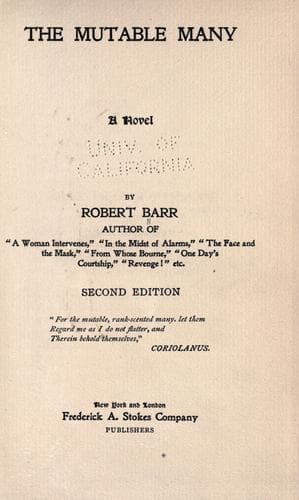
Factories -- Fiction; London (England) -- Fiction; Love stories; Strikes and lockouts -- Fiction
There was tremendous cheering at this, and it was some time before
Gibbons could proceed. Marsten sat silent in his chair, with the
helpless feeling of a criminal in the dock. He felt the chain of
circumstance tightening around him.
“Braunt was a hero in death and a hero in life. He was frankly and
honestly against us from the first, and he fought us with an uprightness
that I wish Sartwell had emulated. He took no strike pay, and used
language against us which I hope has been forgotten, and which I know
has been forgiven. There was nothing underhand in his opposition, and
he broke the back of the strike by hitting from the shoulder when we
had reached the desperation of utter exhaustion. But, while giving full
credit to the splendid character of Braunt, we must not forget that he
was throughout our staunch opponent, and that it was he who elected Mr.
Marsten secretary of this Union.
“Now, gentlemen, I am a plain man, who does not think himself any
better than the average. I do not look for angels with wings among my
fellow-workers; I look for plain, every-day motives when trying to trace
cause from effect. It is not natural for a man to beg for a reduction
of his screw unless that man is an angel, or unless there is some hidden
cause for his doing so. We strike to increase our wages, and I have
never heard of a deputation of workingmen waiting on an employer to ask
for a reduction. Mr. Marsten does what we know to be most unusual, and
what we believe to be unnatural. What is his motive? Who is going to
make up the deficiency in his salary? These are questions for you to
answer. I have tried to state nothing but facts, and no statement I
have made has been contradicted. The result is a chain of circumstantial
evidence that would convict a man in any court in the land. Men have
been hanged on evidence less complete.”
Gibbons sat down amidst universal applause. Marsten rose to his feet
slowly. He knew the meeting was solidly against him, and that he had to
bring it around in his favour or lose the race before it began. There
flashed through his mind the sentence, “It is not the capitalist who
will defeat you, but the men you are fighting for.” He remembered
Braunt’s utter lack of faith in the rope of sand. Then he spoke:
Public-domain text, read in full here on John Shaqi.
Reviews
Reviews
No reviews yet
Be the first to share your thoughts on this work.
Elsewhere in the archive
Join the Discussion
Join the discussion
Sign in to leave a comment or review.
Sign InorCreate an account