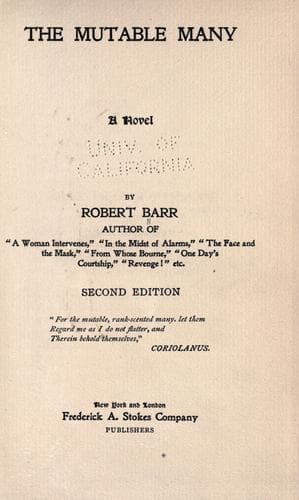
Factories -- Fiction; London (England) -- Fiction; Love stories; Strikes and lockouts -- Fiction
Barney’s people were naturally very proud of him. His father had always
admired him with the intense admiration which a very little man has for
a very big relative; his mother referred to him as, “My son, Barnard
Hope, the celebrated painter.”
To all appearances Barney was a man greatly to be envied, but, alas!
how little does the public know the inner life of even its greatest
favourite! All may be fair to outward view, while within sits brooding
care. Barney had a secret trouble which he confided to no one, and it
caused him serious mental dissatisfaction. He had told Edna Sartwell
that she had blighted his life, and he fully believed this at the time
he made the gloomy statement. He sombrely pictured himself in the future
as a disappointed man--successful, perhaps, but cynically bitter with
existence, living the life of a recluse, and cherishing his broken
heart. As the victim of a hopeless passion, he pitied himself, and yet
took a melancholy pleasure in ruminating over the wreck of what might
have been a joyful career. To his dismay he found it impossible to
live up to his ideal. The forced laugh; the pessimistic smile; the dark
mantle of a great reserve which he hoped to fold around himself, did not
come natural to him, and he was continually backsliding into being his
own hilarious boisterous self, and having a good time, when he should
have been moping alone over an aching void. Above all things he expected
himself to forswear ladies’ society, and never again indulge in
the light, flippant, and complimentary talk in which he had been an
acknowledged master; but it grieved him to discover that he still took
a keen delight in their presence, while they, poor dears! unblushingly
adored Barney as they had always done. His arrival in any room
immediately brightened the occasion, and he was by all odds the most
popular young man in his set. His failure in the tragic _rôle_ he had
marked out for himself at first worried Barney, and led him to suspect
that he was not so deep as he had imagined; but this disquieting thought
gave way under his ultimate realization that the taciturn recluse of
fiction and the drama was merely a melancholy humbug who did not exist
in real life. This comforting discovery did much to place Barney once
more on good terms with himself, and by-and-by he abandoned the attempt
to pose as a stricken victim of woman’s inappreciation, and was once
more the genial host and the welcome guest.
Public-domain text, read in full here on John Shaqi.
Reviews
Reviews
No reviews yet
Be the first to share your thoughts on this work.
Elsewhere in the archive
Join the Discussion
Join the discussion
Sign in to leave a comment or review.
Sign InorCreate an account