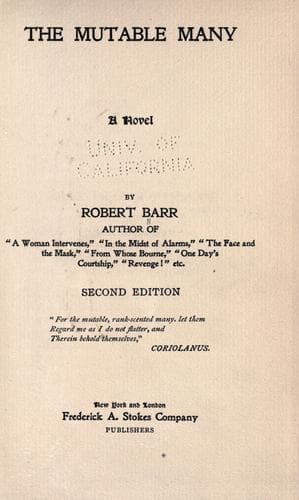
Factories -- Fiction; London (England) -- Fiction; Love stories; Strikes and lockouts -- Fiction
“Giving the increase will probably postpone the trouble for another six
months. I am certain that Marsten wants to force on a fight; he has been
preparing for more than two years. What I want to impress on you is that
the struggle, when it comes, is going to be a severe one, and if you
enter upon it, you must do so with your eyes open, resolved to fight it
to the very end. You may go on conceding until wages are doubled, and
every fresh concession will merely make an ultimate fight the more
inevitable.”
“Then you think we had better make a stand now?”
“Yes; if, having made the stand, you refuse to capitulate on any terms.”
“But if we find, when the strike has lasted a few weeks, that we cannot
hold out, it would be folly to continue.”
“Exactly. You know your own resources, and I know the resources of the
men. You are therefore in as good a position to make up your minds now
as two weeks hence, or a month, or a year. If we enter into a contest we
must win, or I must resign.”
“It is a most perplexing situation,” sighed Mr. Hope.
“Oh, the situation is simple enough. You either give in or you don’t.
Which is it?”
“What are the chances of filling the works with new men, should it prove
impossible to come to terms with our present employees?”
“They are not so good as they were. We could do it gradually, but it
would be some time before we were in full force again.”
“That would mean the refusal of new orders, and perhaps the cancelling
of many now on hand.”
“Undoubtedly. That is the cost of war. We must face it if we fight. We
might be crippled for six months to come.”
“That is very serious. Is no compromise possible? Could you not confer
with Marsten and find out what he wants?”
“I know what he wants.”
“And you think compromise impossible?”
“Frankly, I do.”
“Have you the same objection to meeting Marsten that you had to meeting
Gibbons?”
“As a matter of principle I object to discussing our business with any
outsider. Marsten has never raised that point. When it was necessary to
confer with me he always sent a deputation of our own men. He is a much
more dangerous opponent than Gibbons was.”
“Would you be willing, then, in the interests of peace, to arrange
a conference with Marsten, talk the matter over, and come to an
understanding, if that be possible?”
“Yes. I will send for him at once; but I don’t think it will be of the
slightest use, and it forms a bad precedent.”
It was unanimously agreed that such an action on Sartwell’s part would
strengthen his hands, and that the fight, if it proved inevitable, could
be gone into with greater spirit when all knew that everything possible
had been done to avoid hostilities.
Sartwell invited Marsten to meet him at his office at seven o’clock in
the evening. When the young man entered his first words were:
“You told me I was not to set foot in this office unless I was ordered
to do so; I must apologize, therefore, for coming on a mere invitation.”
Public-domain text, read in full here on John Shaqi.
Reviews
Reviews
No reviews yet
Be the first to share your thoughts on this work.
Elsewhere in the archive
Join the Discussion
Join the discussion
Sign in to leave a comment or review.
Sign InorCreate an account