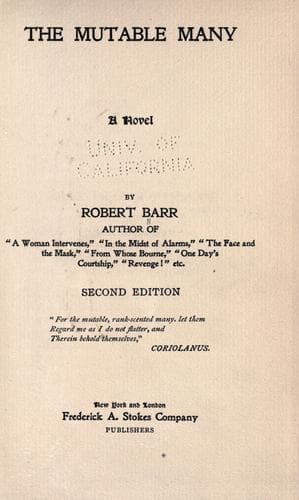
Factories -- Fiction; London (England) -- Fiction; Love stories; Strikes and lockouts -- Fiction
might not countenance such proceedings by her presence. There was a
time to eat and a time to drink, and if a man presumed to be hungry
at midnight, it was a sin that should be punished by dyspepsia in this
world and goodness knows what in the next.
In spite of the compact between them, Sartwell told his daughter little
about the progress of the strike; and she, seeing him indisposed to
speak, forbore to question him, feeling that no suggestion she might
have to offer could be of any value to him, contenting herself with
protecting him from annoyance at home, and cheering him as much as
possible whenever she had him to herself. But it wrung her heart to
see him failing perceptibly day after day, his step, which she eagerly
listened for, losing more and more its selfreliant tread.
One night she sat in his arm-chair waiting for him, thinking deeply. She
looked suddenly up with a start, and saw her father standing beside the
table gazing down at her. His face was white, gaunt, and haggard, and
the gloom of his countenance was deepened rather than relieved by the
sombre smile that parted his lips as he regarded her. He seemed like
a man on the verge of a serious illness, and so startled was the girl,
that for a moment she looked at him with wide-open eyes, fearing that an
apparition stood before her.
“Father!” she cried at last, springing to her feet. “What has happened?”
“Nothing, my girl, except that you have been asleep in the chair when
you should have been in bed long ago.”
“I don’t think I have been asleep, yet I didn’t hear you open the door.
But you are ill.”
“I’m right enough. A little tired, that’s all. No, I won’t have
anything to eat, thank you. It’s after closing hours, I know; but I’m a
traveller, and I’ll have something to drink, if you don’t mind.”
He tried to laugh a little over this attempted pleasantry, but his
laugh sounded dismal, and it frightened the girl still more, instead of
reassuring her, as was his intention. The neck of the decanter clattered
against the glass like chattering teeth, which seemed to annoy Sartwell;
for he muttered something, and shot a glance at his daughter to see if
she had noticed his unusual nervousness. Then he grasped the vessel more
firmly, pouring the liquor with a steadier hand, but the effort made him
tighten his lips. He drank off the liquid and set down the empty glass.
Edna stood opposite him; he looked up at her with a wan smile on his
lips.
“Well, my girl,” he said, “the game’s up.”
“Has the strike ended, father?” she asked, her voice quavering.
“Actually, no; practically, yes. The firm will give in to-morrow, and I
shall resign. Sorry?”
“I am sorry if you are, father,” said Edna, kneeling beside him. “I am
not sorry that the tension has ended, for I think anything is better
than the anxiety you have been undergoing for the past few weeks. And
you look positively ill to-night.”
Public-domain text, read in full here on John Shaqi.
Reviews
Reviews
No reviews yet
Be the first to share your thoughts on this work.
Elsewhere in the archive
Join the Discussion
Join the discussion
Sign in to leave a comment or review.
Sign InorCreate an account