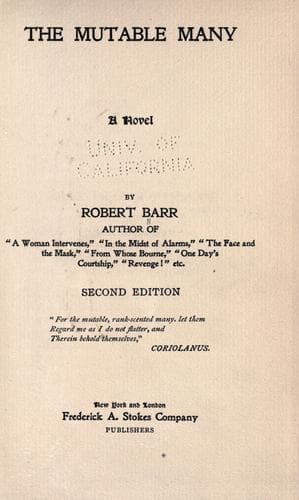
Factories -- Fiction; London (England) -- Fiction; Love stories; Strikes and lockouts -- Fiction
The girl watched the train come in and leave; then, turning, she walked
towards her home with a heavy heart. She went past the house and on to
the Common, unconsciously imitating her father, who, when troubled in
mind, sought its breezy expanse. Several times she paused, and thought
of sending a telegram to Marsten, asking him to meet her in the old
garden at Wimbledon at once. There she fancied herself appealing to
him to put an end to the strike; but she feared the anger of her father
should he discover what she had done, even though it had been done for
his sake. It did not occur to her that perhaps the appeal might be in
vain, for she knew she would do anything asked of her for one she loved,
and she had little doubt that the young man had a true and lasting
affection for her. What, she asked herself, if Marsten made conditions?
Would she be willing to accept a great favour and grant nothing in
return? What would he think if she telegraphed him to come? The answer
was obvious, and, in searching her own heart, she for the first time
admitted to herself that her reply would be different from what it had
been at Eastbourne.
But when it came to the point, she could not bring herself to the length
of sending a message. She shrank from playing so dangerous a card; for,
if it failed to win the trick, how could she face the after-humiliation?
Something in the self-reliant ring of Marsten’s voice, something in the
dogged determination of his manner, something in the compelling glance
of his eye, warned her that not even to please the girl he loved would
he be untrue to the flag under which he fought--and something in her own
heart told her that she herself would think less of him if he did. Yet,
if he refused, she could never speak to him again; she was certain of
that. Having made an appeal in vain, she could never grant one of his
own, or even listen to it. She thought of the pleasure it would be to
her to have him plead his cause once more, and read his answer in her
willing eyes before her lips could speak it; but if he refused her when
she begged him to spare her father the impending humiliation of defeat,
there could be no more friendship between them. Edna at last returned
to her home, bewildered in mind and hesitating to act, and listened to
a homily on the sinfulness of wasting one’s time, although she heard or
understood but little of the admirable discourse.
Public-domain text, read in full here on John Shaqi.
Reviews
Reviews
No reviews yet
Be the first to share your thoughts on this work.
Elsewhere in the archive
Join the Discussion
Join the discussion
Sign in to leave a comment or review.
Sign InorCreate an account