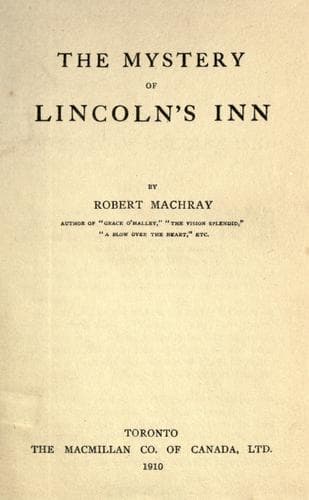
Detective and mystery stories; Embezzlement -- Fiction; England -- Fiction
But Gilbert had no doubts, and in the end Williamson received a note
saying that after that week his services would not be required. At the
same time, the head-clerk was given a handsome cheque as a solatium.
Gilbert next set out for the office of Roscoe and Martin, where he was
fortunate to find Archer Martin. As briefly as possible, Gilbert told
him that he had reason to believe there had been some irregularities in
his father's office, and that his father had deputed him to invite the
accountant to make a searching investigation immediately, if that fitted
in with his engagements.
"As it happens, it does; I can set to work to-morrow," said Martin.
"Of course," said Gilbert, "it is a confidential investigation--that is
understood."
"Certainly," said the accountant, who had no idea that he might
innocently be making himself a party to a fraud.
Archer Martin, accordingly, went to 176, New Square, the following day,
and began his inquiries. Without referring to any one except Gilbert, he
went on his way, steadily plodding through the books and papers of the
firm. His labours extended over several days, but he had not gone very
far when he saw the true character of the work he was engaged on. He
knew there was being disclosed bit by bit a gigantic system of fraud
which involved huge sums of money, and that the system had been
practised remorselessly and with diabolical cunning and ingenuity for
years. He saw that Cooper Silwood, by one means or another, had
appropriated many thousands of pounds, though what he had done with the
cash did not appear. It was plain he had stopped at nothing; there were
false entries everywhere and many forgeries.
He wondered at the ability Silwood had manifested in keeping up
appearances so long. It was evident to him, from various sums of
interest being paid to clients at the proper time, as if their
investments still remained, that Silwood had kept a strict account of
his robberies, but though he searched in Silwood's room, throughout the
rest of the office, and even in Silwood's apartments in Stone Buildings,
for some book or memoranda relating to these robberies, he could not
find it. He came to the conclusion that Silwood had either destroyed it
or taken it with him. He had heard of Silwood's death as well as of the
death of Morris Thornton, and now saw pretty clearly how matters stood.
Failing to light upon Silwood's memoranda, he tried to see what could be
done by tracking out some of the larger transactions of the defaulting
solicitor, which necessarily involved the names of other persons.
And this led him to make an extraordinary discovery, though he did not
think it so extraordinary as it really was.
Public-domain text, read in full here on John Shaqi.
Reviews
Reviews
No reviews yet
Be the first to share your thoughts on this work.
Elsewhere in the archive
Join the Discussion
Join the discussion
Sign in to leave a comment or review.
Sign InorCreate an account