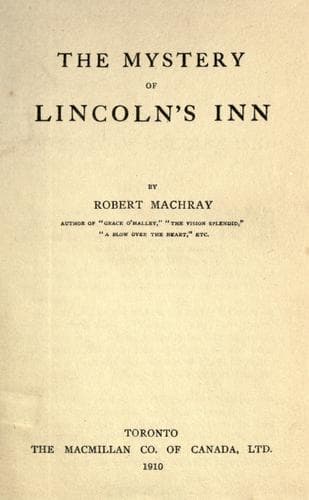
Detective and mystery stories; Embezzlement -- Fiction; England -- Fiction
The papers had announced an inquest was to be held that day, and she
awaited the verdict with sickening apprehension. And what might there
not appear in these journals in addition to the account of the inquest?
Of course, she told herself, it was quite improbable that Bennet would
say anything about the Eversleigh matter at the inquest; but what might
he not say, might he not already have said, to others--to the police,
for instance? She was not long left in doubt as to the line Bennet
intended to take.
The inquest was held in a crowded court which was entirely hostile to
Bennet. And that the jury took the darkest view of Bennet's action soon
was manifest. A local solicitor, called Deakin, had been retained for
him, and he did his best to get a verdict of manslaughter returned, but
even if the evidence had been less convincing than it was, the general
feeling would still have been too strong for him.
There were plenty of witnesses who agreed, with only small verbal
discrepancies which are always a feature of such cases, and confirm
rather than detract from the value of the main volume of testimony, as
to what had passed between Bennet and Bob Deans. The words used by the
two men were quoted by several witnesses with substantial accuracy;
particularly the threat of Bennet to the jockey, "I'll kill you!" was
brought forward by them all, and practically settled in the minds of
coroner and jury the degree of Bennet's guilt.
Bennet, they concluded, had intended killing Bob Deans, and had killed
him. The cause of the murder made Bennet's crime blacker and blacker
still.
His solicitor tried to show there had not been, there could not be, any
premeditation on Bennet's part, and that the deed was done in the heat
of passion without there being any real intention to kill the man. He
urged that the death of the jockey was of the nature of an accident; his
client had certainly struck the blow, but could not know it was likely
to be fatal. The most and worst Bennet was guilty of, Deakin contended,
was manslaughter.
But the jury were of another mind. Without retiring to consider their
verdict, they at once found Bennet guilty of the wilful murder of the
jockey.
It was a verdict which met with general approval. The coroner, in
accepting it, said the case was one of the most painful nature, but as
it would doubtless form matter for the consideration of a higher court,
he would make no further comment upon it.
Public-domain text, read in full here on John Shaqi.
Reviews
Reviews
No reviews yet
Be the first to share your thoughts on this work.
Elsewhere in the archive
Join the Discussion
Join the discussion
Sign in to leave a comment or review.
Sign InorCreate an account