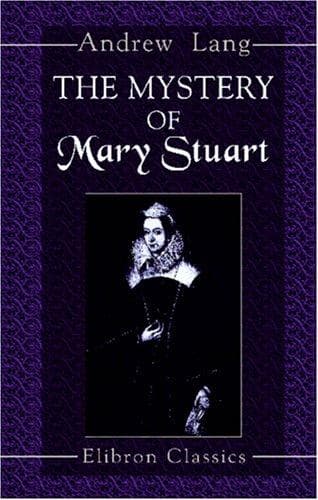
Mary, Queen of Scots, 1542-1587; Queens -- Scotland -- Biography; Scotland -- History -- Mary Stuart, 1542-1567
The one valuable part of Paris’s declarations concerns the carrying of a
Glasgow letter. And that is only valuable if we supply the accusers with
possible dates, in place of their own impossible chronology, and if we
treat as false their tale[176] that Bothwell ‘lodged in the town’ when he
returned from Calendar to Edinburgh. The earlier confessions, especially
those of Tala, were certainly mutilated, as we have seen, and only what
suited the Lords came out. That of Paris was a tool to use against
Lethington, but, as it also implicated Morton, Lindsay, and Ruthven, with
Argyll and Huntly, who might become friends of Morton and Moray, Paris’s
declaration was a two-edged sword, and, probably, was little known in
Scotland. In England it was judiciously withheld from the public eye.
Goodall writes (1754): ‘I well remember that one of our late criminal
judges, of high character for knowledge and integrity, was, by reading it
[Paris’s statement], induced to believe every scandal that had been thrown
out against the Queen.’ A criminal judge ought to be a good judge of
evidence, yet the statements of Paris rather fail, when closely inspected,
to carry conviction.
Darnley, in fact, was probably strangled by murderers of the Douglas and
Lethington branches of the conspiracy. On the whole, it seems more
probable that the powder was placed in Mary’s room than not, though all
contemporary accounts of its effects make against this theory. As touching
Mary, the confessions are of the very slightest value. The published
statements, under examination, of Powrie, Dalgleish, Tala, and Bowton do
not implicate her. That of Bowton rather clears her than otherwise. Thus:
the theory of the accusers, supported by the declaration of Paris, was
that, when the powder was ‘fair in field,’ properly lodged in Mary’s room,
under that of Darnley, Paris was to enter Darnley’s room as a signal that
all was prepared. Mary then left the room, in the time required ‘to say a
paternoster.’ But Bowton affirmed that, as he and his fellows stored the
powder, Bothwell ‘bade them make haste, before the Queen came forth of the
King’s house, for if she came forth before they were ready, they would not
find such commodity.’ This, for what it is worth, implies that no signal,
such as the entrance of Paris, had been arranged for the Queen’s
departure. The self-contradictory statements of Paris can be torn to
shreds in cross-examination, whatever element of truth they may contain.
The ‘dying confessions’ are contradictorily reported, and all the reports
are worthless. The guilt of some Lords, and their alliance with the other
accusers, made it impossible for the Prosecution to produce a sound case.
As their case stands, as it is presented by them, a jury, however
convinced, on other grounds, of Mary’s guilt, would feel constrained to
acquit the Queen of Scots.
VIII
_MARY’S CONDUCT AFTER THE MURDER_
Public-domain text, read in full here on John Shaqi.
Reviews
Reviews
No reviews yet
Be the first to share your thoughts on this work.
Elsewhere in the archive
Join the Discussion
Join the discussion
Sign in to leave a comment or review.
Sign InorCreate an account