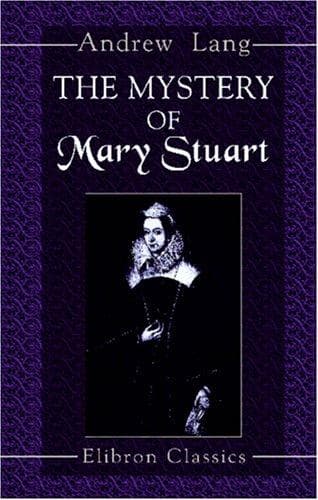
Mary, Queen of Scots, 1542-1587; Queens -- Scotland -- Biography; Scotland -- History -- Mary Stuart, 1542-1567
Of course it is possible that La Mothe Fénelon was not made acquainted
with what his predecessor, La Forest, knew: but this course of
secretiveness would not have been judicious. For the rest, the Court of
France was not in the habit of replying to pamphlets, like that which
contained copies of the Letters. It is unlikely that the copies given to
La Forest were destroyed, but we have no hint or trace of them in France.
Conceivably even if they differed (as we are to argue that they perhaps
did) from the Letters later produced, the differences, though proof of
tampering, did not redound to Mary’s glory. At the time when France was
negotiating Alençon’s marriage with Elizabeth, and a Franco-English
alliance (January-July, 1572), in a wild maze of international, personal,
and religious intrigue, while Catherine de’ Medici was wavering between
massacre of the Huguenots and alliance with them, it is far from
inconceivable that La Forest’s copies of the Letters were either
overlooked, or not critically and studiously compared with the copies now
published. To vex Elizabeth by criticism of two sets of copies of Letters
was certainly not then the obvious policy of France: though the published
Letters were thrust on the French statesmen.
The letters of La Mothe Fénelon, and of Charles IX., on the subject of
Buchanan’s ‘Detection,’ contain no hint that they thought the Letters,
therein published, spurious. They only resent their publication against a
crowned Queen.[218] The reader, then, must decide for himself whether La
Forest’s copies, if extant, were likely to be critically scanned and
compared with the published Letters, in 1571, or in the imbroglio of 1572;
and whether it is likely that, if this was done, and if the two copies did
not tally, French statesmen thought that, in the circumstances, when
Elizabeth was to be propitiated, and the Huguenots were not to be
offended, it was worth while to raise a critical question. If any one
thinks that this course of conduct--the critical comparison of La Forest’s
copies with the published copies, and the remonstrance founded on any
discrepancies detected--was the natural inevitable course of French
statecraft, at the juncture--then he must discredit my hypothesis. For my
hypothesis is, that the Letters extant in June and July, 1567, were not
wholly identical with the Letters produced in December, 1568, and later
published. It is hazarded without much confidence, but certain
circumstances suggest that it may possibly be correct.
Public-domain text, read in full here on John Shaqi.
Reviews
Reviews
No reviews yet
Be the first to share your thoughts on this work.
Elsewhere in the archive
Join the Discussion
Join the discussion
Sign in to leave a comment or review.
Sign InorCreate an account