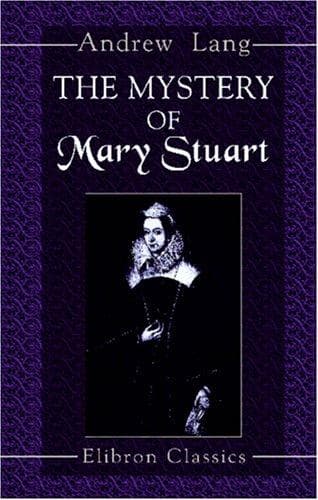
Mary, Queen of Scots, 1542-1587; Queens -- Scotland -- Biography; Scotland -- History -- Mary Stuart, 1542-1567
Mr. Froude first quoted de Silva’s report of Moray’s report of this
bloodthirsty letter of Mary’s: and declared that Moray described
accurately the long Glasgow Letter (Letter II.).[237] But Moray, as Mr.
Hosack proved, described a letter totally and essentially different from
Letter II. That epistle, unlike the one described by Moray, is _not_
signed. We could not with certainty infer this from the want of signatures
to our copies; their absence might be due to a common custom by which
copyists did not add the writer’s signature, when the letter was otherwise
described. But Mary’s defenders, Lesley and Blackwood, publicly complained
of the absence of signatures, and were not answered. This point is not
very important, but in the actual Casket Letter II. Mary does not say, as
in Moray’s account, that there is danger of Darnley’s ‘bringing her round
to his will.’ She says the reverse, ‘The place will hold,’ and, therefore,
she does not, as in Moray’s report, indicate the consequent need of hurry.
She does not say that ‘she herself will go and fetch him;’ she was there
already: this must be an error of reporting. She does not speak of ‘giving
him a draught’ in a house on the road. She says nothing of a house where
‘the explosion was arranged.’ No explosion had been arranged, though some
of the earlier indictments drawn up by Lennox for the prosecution declare
that this was the case: ‘The place was already prepared with [undermining
and] trains of powder therein.’[238] This, however, was the early theory,
later abandoned, and it occurs in a Lennox document which contains a
letter of Darnley to the Queen, written three days before his death. The
Casket Letter II. says nothing about poisoning or divorcing Lady Bothwell,
nor much, in detail, about Mary’s abandonment of her God, her wealth _in
France_, and her realm, for her lover. On the other hand she regards God
as on her side. In short, the letter described by Moray to de Silva agrees
in no one point with any of the Letters later produced and published:
except in certain points provocative of suspicion. Mr. Froude thought that
it did harmonise, but the opinion is untenable.
De Silva’s account, however, is only at third hand. He merely reports what
Moray told him that _he_ had heard, from ‘a man who had read the letter.’
We might therefore argue that the whole reference is to the long Casket
Letter II., but is distorted out of all knowledge by passing through three
mouths. This natural theory is no longer tenable.
Public-domain text, read in full here on John Shaqi.
Reviews
Reviews
No reviews yet
Be the first to share your thoughts on this work.
Elsewhere in the archive
Join the Discussion
Join the discussion
Sign in to leave a comment or review.
Sign InorCreate an account