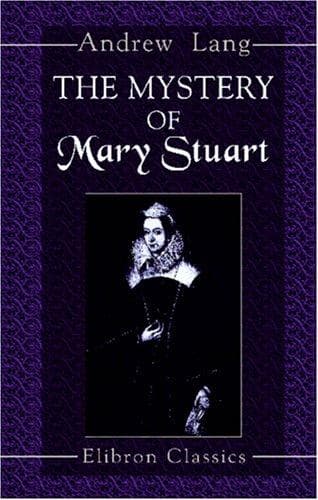
Mary, Queen of Scots, 1542-1587; Queens -- Scotland -- Biography; Scotland -- History -- Mary Stuart, 1542-1567
privately displayed the Casket Letters, he secretly intrigued for her at
York. Even his final accession (1569) to her party, and his death in her
cause, did not win her forgiveness.
She dated from Carberry Hill her certain knowledge of his guilt in the
murder, which she always held in reserve for a favourable opportunity.
But, as she neither was allowed to see the Casket Letters, nor to appear
in person before the Peers, that opportunity never came.
To conclude this part of the inquiry: Mary’s attitude, as regards the
Letters, was less that of conscious innocence, than of a player who has
strong cards in her hand and awaits the chance of bringing out her
trumps.
XIV
_INTERNAL EVIDENCE OF THE LETTERS_
LETTER I
This Letter, usually printed as Letter I., was the first of the Casket
Letters which Mary’s accusers laid before the Commission of Inquiry at
Westminster (December 7, 1568).[332] It does not follow that the accusers
regarded this Letter as first in order of composition. There exists a
contemporary copy of an English translation, hurriedly made from the
French; the handwriting is that of Cecil’s clerk. The endorsing is, as
usual, by a Scot, and runs, ‘Ane short Lettre from Glasco to the Erle
Bothwell. Prufes her disdaign against her husband.’ Possibly this Letter,
then, was put in _first_, to prove Mary’s hatred of Darnley, and so to
lead up to Letter II., which distinctly means murder. If the accusers,
however, regarded this piece (Letter I.) as first in order of composition,
they did not understand the meaning and drift of the papers which they had
seized.[333]
Letter I., so called, must be, in order of composition, a sequel to Letter
II. The sequence of events would run as follows: if we reject the
chronology as given in ‘Cecil’s Journal,’ a chronological summary handed
to Cecil, we know not by whom, and supply the prosecution with a feasible
scheme of time. ‘Cecil’s Journal’ makes Mary leave Edinburgh on January
21, stay at Lord Livingstone’s house of Callendar (not Callander in
Perthshire) till January 23, and then enter Glasgow. If this is right,
Letters I. and II. are forgeries, for II. could not, by internal evidence,
have been finished before Mary’s second night, at least, in Glasgow,
which, if she arrived on January 23, would be January 24. Consequently it
could not (as in the statement of Paris, the alleged bearer) reach
Bothwell the day before his departure for Liddesdale, which ‘Cecil’s
Journal’ dates on January 24. Moreover, on the scheme of dates presented
in ‘Cecil’s Journal,’ Mary must have written and dispatched Letter I. on
the morning of January 25 to Bothwell, whom it could not reach (for he was
then making a raid on the Elliots, in Liddesdale), and Mary must, at the
same time, have been labouring at the long Letter II. All this, with other
necessary inferences from the scheme of dates, is frankly absurd.[334]
Public-domain text, read in full here on John Shaqi.
Reviews
Reviews
No reviews yet
Be the first to share your thoughts on this work.
Elsewhere in the archive
Join the Discussion
Join the discussion
Sign in to leave a comment or review.
Sign InorCreate an account