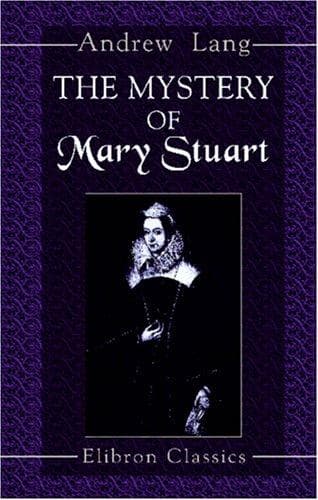
Mary, Queen of Scots, 1542-1587; Queens -- Scotland -- Biography; Scotland -- History -- Mary Stuart, 1542-1567
But it escaped the notice of the accusers that all the world, or all whom
Crawford chose to inform as to what Darnley told him about these
conversations, might know the details of the talk even better than Mary
herself. For the precise words would fade from Mary’s memory, whereas
Crawford, as he swore, had written them down at once, as reported to him
by Darnley, probably as soon as Mary left his sick-room. The written copy
by Crawford must have preserved the words with fidelity beyond that of
human memory, and the written words were in the custody of Crawford, or of
Lennox, so long as they chose to keep the manuscript. This fact is proved
on Crawford’s oath. On December 9, 1568, before the Commissioners, he
swore that, when with Darnley, in Glasgow, in January, 1567, ‘he was
secretly informed by the King of all things which had passed betwixt the
said Queen and the King, ... to the intent that he should report the same
to the Earl of Lennox, his Master, and that he did, _immediately at the
same time, write the same word by word_ as near as he could possibly carry
the same away.’ He was certain that his report of Mary’s words to himself,
‘the words now reported in his writing,’ ‘are the very same words, on his
conscience, that were spoken,’ while Darnley’s reports of Mary’s talk
(also contained in Crawford’s written deposition) are the same in effect,
‘though not percase in all parts the very words themselves.’[343]
We do not know whether what Crawford now handed in on December 9, 1568,
was an English version of his own written verbatim Scots report done in
January, 1567; or a copy of it; or whether he copied it from Letter II.,
or whether he rewrote it from memory after nearly two years. The last
alternative may be dismissed as impossible, owing to the verbal identity
of Crawford’s report with that in the Scots version of the French Letter
attributed to Mary. Another thing is doubtful: whether Lennox, at
Chiswick, on June 11, 1568, did or did not possess the report which
Crawford wrote for him in January, 1567. Lennox, on June 11, as we saw,
wrote to Crawford asking ‘what purpose Crawford held with her’ (Mary) ‘at
her coming to the town’ of Glasgow. He did not ask what conversation Mary
then held with Darnley. Either he had that principal part of Crawford’s
report, in writing, in his possession, or he knew nothing about it (which,
if Crawford told truth, is impossible), or he forgot it, which is next to
impossible. All he asked for on June 11 was Crawford’s recollection about
what passed between himself and Mary ere she entered Glasgow, concerning
which Crawford nowhere says that he made any written memorandum. Lennox,
then, on June 11, 1568, wanted Crawford’s recollections of his own
interview with the Queen, either to corroborate Letter II., if it then
existed; or for secret purposes of Wood’s, who was with him.
Public-domain text, read in full here on John Shaqi.
Reviews
Reviews
No reviews yet
Be the first to share your thoughts on this work.
Elsewhere in the archive
Join the Discussion
Join the discussion
Sign in to leave a comment or review.
Sign InorCreate an account