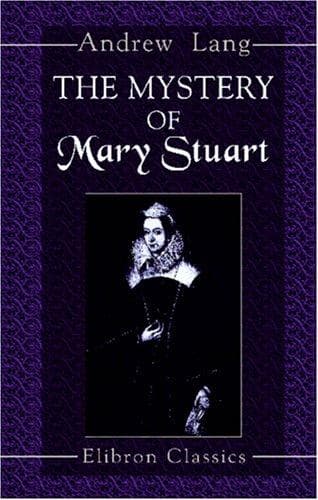
Mary, Queen of Scots, 1542-1587; Queens -- Scotland -- Biography; Scotland -- History -- Mary Stuart, 1542-1567
5. The contents of the Letter are said to be incoherent and inconsistent
with Mary’s style and character. The last objection is worthless. In the
Letter she says that she acts ‘against her natural’--_contre son
naturel_--out of character. As for incoherence, the items of her memoranda
are closely followed in sequence, up to paragraph 8, and the interloping
part in paragraph 12. The rest, the work of the second night, _is_
incoherent, as Mary’s moods, if she was guilty, must have been.
Information, hatred, remorse, jealousy, and passion are the broken and
blended strata of a mind rent by volcanic affections. The results in the
Letter are necessarily unlike the style and sentiment of Mary’s authentic
letters, except in certain very remarkable features.
Either Mary wrote the Letter or a forger wished to give the impression
that this occurred. He wanted the world to believe that the Queen, her
conscience tortured and her passion overmastering her conscience, could
not cease to converse with her lover while paper served her turn. Her
moods alternate: now she is resolved and cruel, now sick with horror, but
still, sleepless as she is, she must be writing. Assuredly if this Letter
be, in part at least, a forgery, it is a forgery by a master in the
science of human nature. We seem to be admitted within the room where
alone a light burns through the darkling hours, and to see the tormented
Queen who fears her pillow. She writes, ‘I would have almaist had pitie of
him.... He salutes everybody, yea unto the least, and makes pitious
caressing unto them, to make them have pitie on hym,’ a touching picture.
There is a pendant to this picture of Darnley, in Buchanan’s ‘History.’ He
is speaking of Mary’s studied neglect of Darnley at the time of his son’s
christening (December, 1566). Darnley, he says, endured all ‘not only with
patience; he was seen trying to propitiate her unjust anger in every way,
_that humbly, and almost in servile fashion_, he might keep some share in
her good graces.’[350] What an etching is this of the man, a little while
since so haughty and tyrannous, ‘dealing blows where he knew that they
would be taken’! Again the passage (Letter II. 11) about Mary’s heart
wherein only Bothwell’s ‘shot’ can make a breach, does certainly seem (as
Laing notes) to refer to a sonnet of Mary’s favourite poet, Ronsard.
Depuis le jour que la première flèche
De ton bel oëil m’avança la douleur,
Et que sa blanche et sa noire couleur,
Forçant ma force, _au cœur me firent brèche_.
As in later letters, the writer now shows jealousy of Bothwell’s wife.
Public-domain text, read in full here on John Shaqi.
Reviews
Reviews
No reviews yet
Be the first to share your thoughts on this work.
Elsewhere in the archive
Join the Discussion
Join the discussion
Sign in to leave a comment or review.
Sign InorCreate an account