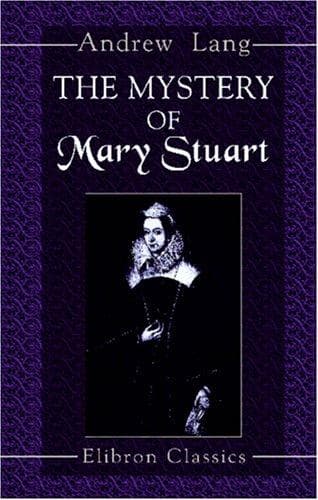
Mary, Queen of Scots, 1542-1587; Queens -- Scotland -- Biography; Scotland -- History -- Mary Stuart, 1542-1567
The passion, in the Letters, is all on the side of Mary. By her eternal
protests of entire submission she recalls to us at once her eager service
to Darnley in the first days of their marriage, and her constant promises
of implicit obedience to Norfolk. To Norfolk, as to Bothwell (we have
already shown), she expresses her hope that ‘you will mistrust me no
more.’[382] ‘If you be in the wrong I will submit me to you for so
writing, and ax your pardon thereof.’ She will beg pardon, even if Norfolk
is in the wrong! Precisely in the same tone does Mary (in Letter VIII.),
after complaining of Bothwell’s forgetfulness, say, ‘But in spite of all I
will not accuse you, either of your scant remembrance or scant care, and
still less of your broken promise, seeing that what pleases you pleases
me.’
This woman, whose pride is said to be in contradiction with her
submission, as expressed in the Casket Letters, writes even to Elizabeth,
‘Je me sousmetray à vos commandemants.’[383] In Letter VIII. Bothwell is
congratulated on ‘votre victoire et mon agreable perte.’ To Elizabeth Mary
writes ‘Vous aurés fayt une profitable conqueste de moy.’
That any forger should have known Mary so well as to place her,
imaginatively, as regarded Bothwell, in the very attitude which we see
that, on occasion, she chose later to adopt in fact, as regarded Norfolk,
is perhaps beyond belief. It may be urged that she probably, in early
days, wrote to Darnley in this very tone, that Darnley’s papers would fall
into his father’s hands, and that Lennox would hand them over as materials
to the forger. But ‘it is to consider too curiously to consider thus.’
Such are the arguments, for the defence and the attack, which may be drawn
from internal evidence of style. To myself this testimony seems rather in
favour of the authenticity of considerable and compromising portions of
the papers.
Letter VIII. (intended to prove a contract of marriage with Bothwell)
remains an enigma to me: the three Letters proving Mary’s eagerness for
the abduction are not without suspicious traits. The epistle about
bringing Lord Robert to kill Darnley in a quarrel is involved in the
inconsistencies which we have shown to beset that affair. The note about
the waiting-woman was hardly worth forging, compromising as it is. Letter
I. seems to me certainly authentic, if we adopt the scheme of dates
suggested, and reject that of ‘Cecil’s Journal,’ which appears to be
official, and answers to Lennox’s demands for dates. It may be merely
Lennoxian, but no other scheme of chronology is known to have been put in
by the accusers. Letter I., if our dates are admitted, implies the
existence of a letter answering to Letter II., which I have had to regard
as, in some parts at least, genuine. If forgery and tampering were
attempted (as I think they certainly were in the letter never produced,
but described by Lennox and Moray, and perhaps in other cases), who was
the criminal?
Public-domain text, read in full here on John Shaqi.
Reviews
Reviews
No reviews yet
Be the first to share your thoughts on this work.
Elsewhere in the archive
Join the Discussion
Join the discussion
Sign in to leave a comment or review.
Sign InorCreate an account