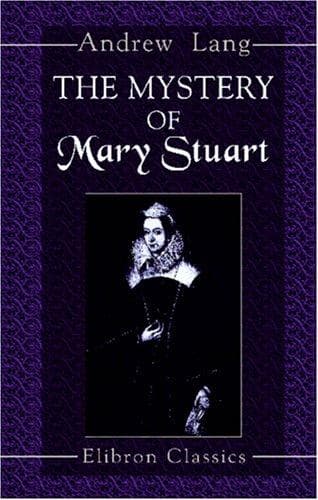
Mary, Queen of Scots, 1542-1587; Queens -- Scotland -- Biography; Scotland -- History -- Mary Stuart, 1542-1567
6. We have already cited Randolph’s letter to Kirkcaldy and Lethington,
when they had changed sides, and were holding the Castle for the Queen.
But we did not quote all of the letter. Lethington, says Randolph, with
Grange, is, as Mary herself has said, the chief occasion of all her
calamities, by his advice ‘to apprehend her, to imprison her; yea, to have
taken presently the life from her.’ This follows a catalogue of
Lethington’s misdeeds towards Mary, exhaustive, one might think. But it
ends, ‘_with somewhat more that we might say, were it not to grieve you
too much herein_.’ What ‘more’ beyond arrest, loss of crown, prison, and
threatened loss of life, was left that Lethington could do against Mary?
The manipulation of the Casket Letters was left: ‘somewhat more that we
might say, were it not to grieve you too much herein.’[394]
Randolph had been stirring the story of Lethington’s opening the coffer in
a green cover, in the autumn of 1570. Charges and counter-charges as to
the band for murdering Darnley had been flying about. On January 10, 1571,
Cecil darkly writes to Kirkcaldy that of Lethington he ‘has heard such
things as he dare not believe.’[395] This cannot refer to the declaration,
by Paris, that Lethington was in the murder, for _that_ news was stale
fifteen months earlier.
As to the hand that may have done whatever unfair work was done, we can
hope for no certainty. Robert Melville, in 1573, being taken out of the
fallen Castle, and examined, stated that ‘he thinkis that the lard of
Grange’ (Kirkcaldy) ‘counterfaitit the Regentis’ (Moray’s) ‘handwrite,
that was sent to Alixr Hume that nycht.’ But we do not accuse Kirkcaldy.
There is another possible penman, Morton’s jackal, a Lord of Session,
Archibald Douglas. That political forgery was deemed quite within the
province of a Scottish Judge, or Lord of Session, in the age of the
Reformation, we learn from his case. A kinsman of Morton, one of Darnley’s
murderers, and present, according to Morton, at the first opening of the
Casket, Archibald was accused by his elder brother, William Douglas of
Whittingham, of forging letters from Bishop Lesley to Lennox, the
favourite of James VI., and others (1580-1581).[396] Of course a Lord of
Session might bear false witness against his brother in the flesh, and on
the Bench. But perhaps Archibald himself, a forger of other letters,
forged the Casket Letters; he had been in France, and may have known
French. All things are conceivable about these Douglases.
It is enough to know that experts in forgery, real or reputed, were among
Mary’s enemies. But, for what they are worth, the hints which we can still
pick up, and have here put together, may raise a kind of presumption that,
if falsification there was, the manager was Lethington. ‘The master wit of
Lethington was there to shape the plot,’ said Sir John Skelton, though
later he fell back on Morton, with his ‘dissolute lawyers and unfrocked
priests’--like Archie Douglas.
Public-domain text, read in full here on John Shaqi.
Reviews
Reviews
No reviews yet
Be the first to share your thoughts on this work.
Elsewhere in the archive
Join the Discussion
Join the discussion
Sign in to leave a comment or review.
Sign InorCreate an account