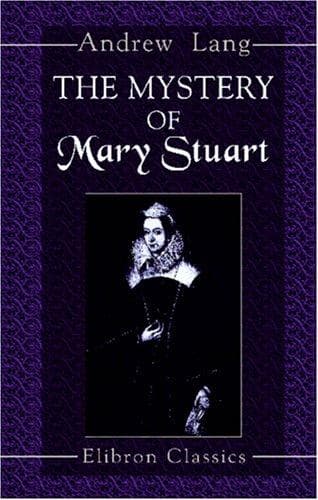
Mary, Queen of Scots, 1542-1587; Queens -- Scotland -- Biography; Scotland -- History -- Mary Stuart, 1542-1567
For the rest, the conspiracy against Moray, in July, 1568, and the secret
as to the cause of Lyon Herald’s death, remain mysterious.[414]
APPENDIX C
THE DATE OF MARY’S VISIT TO GLASGOW
The question of the possibility that Letter II. may be authentic turns on
dates. If the Lords are right in declaring, in ‘Cecil’s Journal,’ that
Mary left Edinburgh on January 21, 1567, and arrived in Glasgow on January
23, then the evidence of the Letter is incompatible with that of Paris,
and one or both testimonies must be abandoned. They fare no better if we
accept the statement of Drury, writing from Berwick, that Mary entered
Glasgow on January 22. It is shown in the text that, if we accept the date
as given in Birrel’s ‘Diary,’ and also in the ‘Diurnal of Occurrents’: if
we make Mary leave Edinburgh on January 20, and (contrary to Drury and
‘Cecil’s Journal’) make her enter Glasgow on January 21, then the Letter
may be brought into harmony with the statement of Paris.
Of course it may be argued that the ‘Diurnal’ and Birrel’s ‘Diary’
coincide in an error of date. The ‘Diary’ of Birrel describes itself as
extending from 1532 to 1605. One man cannot have kept a daily note of
events for seventy-three years. The ‘Diary,’ in fact, is _not_ a daily
record. There is but one entry for 1561, one for 1562, one for 1565, ten
for 1566, and twenty-four for 1567; up to Mary’s surrender at Carberry
(June 15). The ‘Diurnal,’ for our period, is more copious, and is by a
contemporary, though probably he did not always write his remarks on the
day of the occurrence noted.
From August 19, 1561, to June 15, 1567, the ‘Diurnal’ and the ‘Diary’
record in common twenty-one events, with date. In seven of these cases
they differ, as to date. They differ as to the day of Mary’s departure
from Edinburgh to Jedburgh, as to the departure of the ambassadors from
Stirling, as to the arrival of Mary with her infant child in Edinburgh
(January, 1567), as to the return of Mary and Darnley from Glasgow, as to
the day of Darnley’s burial, as to the day of opening Parliament, and as
to the attack on Borthwick Castle by the Lords: while the ‘Diurnal’ makes
the explosion at Kirk o’ Field occur at 2 A.M. on February 10, but ends
the Parliament on April 29, which is absurd. When the dates are correctly
known from other sources, and when the ‘Diary’ and the ‘Diurnal’ coincide
as to these dates, then, of course, we may accept their authority. But
when, as in the case of Mary’s departure from Edinburgh, and arrival in
Glasgow, the ‘Diary’ and ‘Diurnal’ oppose ‘Cecil’s Journal,’ and Drury’s
version, every reader must estimate the value of their coincidence for
himself. If their date, January 20, is correct, then a letter may have
been written, and sent, and received, and the facts, so far, are
corroborated by Paris’s deposition.
Public-domain text, read in full here on John Shaqi.
Reviews
Reviews
No reviews yet
Be the first to share your thoughts on this work.
Elsewhere in the archive
Join the Discussion
Join the discussion
Sign in to leave a comment or review.
Sign InorCreate an account