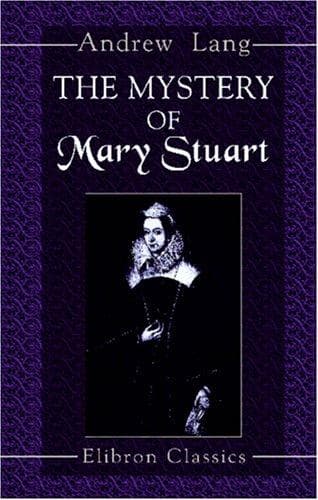
Mary, Queen of Scots, 1542-1587; Queens -- Scotland -- Biography; Scotland -- History -- Mary Stuart, 1542-1567
[186] Keith knew a copy in the Scots College at Paris, attested by Sir
James Balfour as ‘the authentick copy of the principall band.’ This copy
Sir James sent to Mary, in January, 1581, after Morton’s arrest. The names
of laymen are Huntly, Argyll, Morton, Cassilis, Sutherland, Errol,
Crawford, Caithness, Rothes, Boyd, Glamis, Ruthven, Semple, Herries,
Ogilvy, Fleming. John Read’s memory must have been fallacious. There are
eight prelates in Balfour’s band, including Archbishop Hamilton, the
Bishop of Orkney, who joined in prosecuting Mary, and Lesley, Bishop of
Ross (Keith, ii. 562-569). On the whole subject see a discussion by Mr.
Bain and Mr. Hay Fleming, in _The Genealogist_, 1900-1901. Some copies are
dated April 20. See Fraser, _The Melvilles_, i. 89.
[187] Spanish Calendar, i. 662.
[188] Cal. For. Eliz. viii. 213.
[189] Bain, ii. 323, 324.
[190] Melville, p. 177.
[191] Melville, p. 178.
[192] Drury to Cecil, Cal. For. Eliz. viii. 222.
[193] Cal. For. Eliz. viii. 223-224.
[194] May 6, Drury to Cecil.
[195] Drury to Cecil, May 6. Cal. For. Eliz. viii. 223, 224.
[196] Undated letter in Bannatyne, of 1570-1572.
[197] See Stewart’s _Lost Chapter in the History of Queen Mary_ for the
illegalities of the divorce. The best Catholic opinion is agreed on the
subject.
[198] Melville, 182. Teulet, ii. 153, 170.
[199] Cal. For. Eliz. viii. 235.
[200] Drury to Cecil, Cal. For. Eliz. viii. 240.
[201] Dates from James Beaton’s letter of June 17. Laing, ii. 106, 115.
[202] Nau, 46-48.
[203] Laing, i. 113. June 17, 1567.
[204] Melville, p. 183.
[205] Teulet, ii. 179.
[206] Teulet, ii. 169, 170. June 17.
[207] Bannatyne’s _Memorials_, p. 126.
[208] Nau, 50-54.
[209] Laing, ii, 115.
[210] Bannatyne, _Journal_, 477, 482.
[211] Chalmers, _Life of Mary, Queen of Scots_ (1818), ii. 486, 487, note.
I do not understand Randolph to bring these charges merely on the ground
of Mary’s word. _That_ he only adds as corroboration, I think, of facts
otherwise familiar to him.
[212] Mr. Froude has observed that the Lords, ‘uncertain what to do, sent
one of their number in haste to Paris, to the Earl of Moray, to inform him
of the discovery of the Letters, and to entreat him to return
immediately.’ Mr. Hosack says that Mr. Froude owes this circumstance
‘entirely to his imagination.’ This is too severe. The Lords did not send
‘one of their number’ to Moray, but they sent letters which Robert
Melville carried as far as London, and, seventeen days later, they did
send a man who, if not ‘one of their number,’ was probably Moray’s agent,
John Wood (Hosack, i. 352).
[213] Cal. For. Eliz. viii. p. 261.
[214] Spanish Calendar, i. 657.
[215] Cal. For. Eliz. ix. pp. 354, 355.
[216] Fénelon, _Dépêches_ (1838), i. 19, 20.
[217] Fénelon, i. 22. To this point we shall return.
[218] La Mothe Fénelon, vii. 275-276.
[219] Cal. Span. i. 659.
[220] Bain, ii. 336.
[221] Bain, ii. 338.
[222] Bain, ii. 339.
[223] Bain, ii. 341.
Public-domain text, read in full here on John Shaqi.
Reviews
Reviews
No reviews yet
Be the first to share your thoughts on this work.
Elsewhere in the archive
Join the Discussion
Join the discussion
Sign in to leave a comment or review.
Sign InorCreate an account