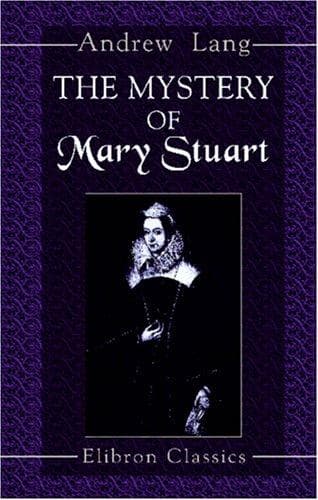
Mary, Queen of Scots, 1542-1587; Queens -- Scotland -- Biography; Scotland -- History -- Mary Stuart, 1542-1567
Mary had come back to Edinburgh from Dumfries by October 18, 1565. Riccio
was already, indeed by September 22, complained of as a foreign upstart,
but not as a lover of Mary, by the rebel Lords.[29] The Lennox Papers
attribute the estrangement of Mary and Darnley to her pardoning without
the consent of the King, her husband, ‘sundry rebels,’ namely the
Hamiltons. The pardon implied humiliation and five years of exile. It was
granted about December 3.[30] The measure was deeply distasteful to
Darnley and Lennox, who had long been at mortal feud, over the heirship to
the crown, with the Lennox Stewarts. The pardon is attributed to the
influence of ‘Wicked David,’ Riccio. But to pardon perpetually was the
function of a Scottish prince. Soon we find Darnley intriguing for the
pardon of Moray, Ruthven, and others, who were not Hamiltons. Next, Lennox
complains of Mary for ‘using the said David more like a lover than a
husband, forsaking her husband’s bed and board very often.’ But this was
not before November. The ‘Book of Articles’ put in against Mary by her
accusers is often based on Lennox’s papers. It says ‘she suddenly altered
the same’ (her ‘vehement love’ of Darnley) ‘about November, for she
removed and secluded him from the counsel and knowledge of all Council
affairs.’[31] The ‘Book of Articles,’ like Lennox’s own papers, omits
every reference to Riccio that can be avoided. The ‘Book of Articles,’
indeed, never hints at his existence. The reason is obvious: Darnley had
not shone in the Riccio affair. Moreover the Lennox party could not accuse
Mary of a guilty amour before mid November, 1565, for James VI. was born
on June 19, 1566. It would not do to discredit his legitimacy. But, as
early as September 1565, Bedford had written to Cecil that ‘of the
countenance which Mary gave to David he would not write, for the honour
due to the person of a Queen.’[32] Thus, a bride of six weeks, Mary was
reported to be already a wanton! Moreover, on October 13, 1565, Randolph
wrote from Edinburgh that Mary’s anger against Moray (who had really
enraged her by rising to prevent her from marrying Darnley) came from some
dishonourable secret in Moray’s keeping, ‘not to be named for reverence
sake.’ He ‘has a thing more strange’ even than the fact that Mary ‘places
Bothwell in honour above every subject that she hath.’ As the ‘thing’ is
_not_ a nascent passion for Bothwell, it may be an amour with Riccio.[33]
Indeed, on October 18, 1565, he will not speak of the cause of mischief,
but hints at ‘a stranger and a varlet,’ Riccio.[34] Randolph and the
English diplomatists were then infuriated against Mary, who had expelled
their allies, Moray and the rest, discredited Elizabeth, their
paymistress, and won over her a diplomatic victory. Consequently this talk
of her early amour with Riccio, an ugly Milanese musician, need not be
credited. For their own reasons, the Lennox faction dared not assert so
early a scandal.
Public-domain text, read in full here on John Shaqi.
Reviews
Reviews
No reviews yet
Be the first to share your thoughts on this work.
Join the Discussion
Join the discussion
Sign in to leave a comment or review.
Sign InorCreate an account