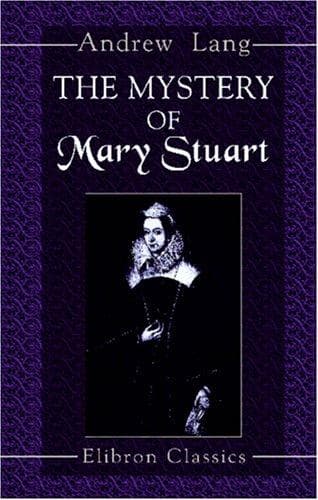
Mary, Queen of Scots, 1542-1587; Queens -- Scotland -- Biography; Scotland -- History -- Mary Stuart, 1542-1567
We now see why it was that, in the height of her final triumph, the
christening festival at Stirling Mary wept and was ill at ease. Her
husband’s conduct was intolerable: now he threatened to leave before the
ceremony, next he stayed on, a dismal figure behind the scenes. His guard
of Lennox men might aim at slaying Bothwell, or Mary might think, on
Walker’s evidence, that they intended to kidnap her child. Worse followed,
when she and her Council examined Walker. Out came the tale of Hiegait,
and Queen and Council, if they had really plotted to arrest Darnley, knew
that their scheme was discovered and was abortive. Finally, on December
24, either in consequence of Lennox’s warning, or because Morton, Lindsay,
and the other Riccio conspirators whom he betrayed were pardoned, Darnley
rode off to his father at Glasgow. There he fell ill, soon after his
arrival, but Lennox’s MSS. never hint that he was poisoned at Stirling (as
Buchanan declares), or that he fell sick when he had ridden but a mile
from the town. That they deny.
After Darnley’s departure, Moray, with Bedford, the English Ambassador,
went to St. Andrews, and other places in Fife. Till January 2, 1567, when
she returned to Stirling, Mary was at Drummond Castle, and at
Tullibardine, where, says Buchanan, she and Bothwell made love in corners
‘so that all were highly offended.’ After January 13, she visited Calendar
House, and then went to Holyrood.
It is said that she never wrote to Darnley till after January 14, when she
took her child to Edinburgh, with the worst purposes, Buchanan declares.
Then she wrote to Darnley, the Lennox Papers inform us, excusing herself,
and offering to visit him in his sickness at Glasgow. Darnley told her
messenger verbally, say the Lennox MSS., that the Queen must judge herself
as to the visit to him. ‘But this much ye shall declare unto her, that I
wish Stirling to be Jedburgh, and Glasgow to be the Hermitage, and I the
Earl of Bothwell as I lie here, and then I doubt not but she would be
quickly with me undesired.’ This was a tactless verbal message, and, if
given, must have proved to Mary that Darnley suspected her amour.
Moreover, this Lennoxian story, that Mary offered the visit, and that
Darnley replied with reserve, and with an insult to be verbally delivered,
agrees ill with what is said in the deposition (December, 1568) of
Lennox’s retainer, Thomas Crawford. According to Crawford, ‘after theire
metinge and shorte spekinge together she asked hym of hys lettres, wherein
he complained of the crueletye of som.’ ‘He answered that he complained
not without cause....’ ‘Ye asked me what I ment bye the crueltye specified
in my lettres, yt procedeth of you onelye that wille not accept mye
_offres_ and repentance.’ Now, in the Lennox Papers this ‘innocent lamb’
has nothing to repent of, and has made no offers. These came from Mary’s
side.[109]
Public-domain text, read in full here on John Shaqi.
Reviews
Reviews
No reviews yet
Be the first to share your thoughts on this work.
Elsewhere in the archive
Join the Discussion
Join the discussion
Sign in to leave a comment or review.
Sign InorCreate an account