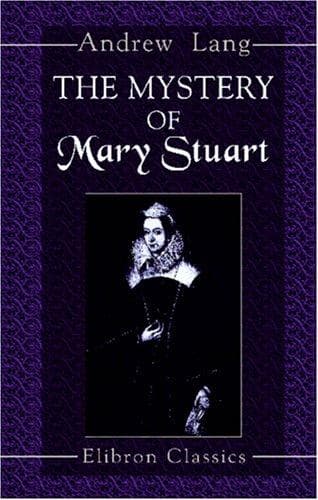
Mary, Queen of Scots, 1542-1587; Queens -- Scotland -- Biography; Scotland -- History -- Mary Stuart, 1542-1567
Still, we have seen no contemporary evidence, or hint of evidence, that
love for Bothwell was Mary’s master. Her conduct, from her recovery of
power, after Riccio’s murder, to her reconciliation of Lethington with
Bothwell, is, on the face of it, in accordance with the interests and
wishes of her brother, Moray, who hated Bothwell. As the English envoy,
Randolph, had desired, she brought Moray to Court. She permitted him to
attend in the Castle while she was in child-bed, and ‘refused Bothwell.’
She protected Moray from Bothwell’s and Darnley’s intrigues. She took
Moray’s side, as to the readmission of Lethington to favour, though
Bothwell stormed. She even made Moray her confidant as to money received
from the Pope: perhaps Moray had his share! Lethington and Moray, not
Bothwell, seem to have had her confidence. At Moray’s request she annulled
her restoration of consistorial jurisdiction to Archbishop Hamilton. Moray
and Lethington, not Bothwell, opened the proposals at Craigmillar. Such is
the evidence of history. On the other side are the scandals reported by
Buchanan, and, in details, Buchanan erred: for example, as to the ride to
Hermitage.
If Mary knew too much, how much was known by ‘the noble, stainless Moray’?
As to Moray’s foreknowledge of Darnley’s murder, can it be denied? He did
not deny that he was at Craigmillar during the conference as to
‘dispatching’ Darnley. If the news of the plan for arresting or killing
him reached underlings like Hiegait and Walker, could it be hidden from
Moray, the man most in Mary’s confidence, and likely to be best served by
spies? He glosses over his signature to the band of early October,
1566--the anti-Darnley band--as if it were a mere ‘sign of reconciliation’
which he promised to subscribe ‘before I could be admitted to the Queen’s
presence, or have any show of her favour.’ But, when he did sign, he had
possessed Mary’s favour for more than three months, and she had even saved
him from a joint intrigue of Bothwell and Darnley. In January, 1569, Moray
declared that, except the band of early October, 1566, ‘no other band was
proposed to me in any wise,’ either before or after Darnley’s murder. And
next he says that he would never subscribe any band, ‘howbeit I was
earnestly urged and pressed thereto by the Queen’s commandment.’[118] Does
he mean that no band was proposed to him, and yet that the Queen did press
him to sign a band? Or does he mean that he would never have signed, even
if the Queen had asked him to do so? We can never see this man’s face; the
fingers through which he looks on at murder hide his shifty eyes.
VI
_THE MURDER OF DARNLEY_
Public-domain text, read in full here on John Shaqi.
Reviews
Reviews
No reviews yet
Be the first to share your thoughts on this work.
Elsewhere in the archive
Join the Discussion
Join the discussion
Sign in to leave a comment or review.
Sign InorCreate an account