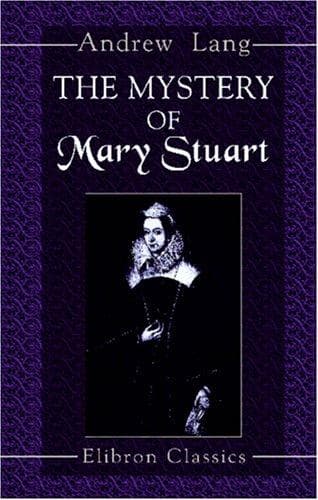
Mary, Queen of Scots, 1542-1587; Queens -- Scotland -- Biography; Scotland -- History -- Mary Stuart, 1542-1567
But on February 11, 1567, two women, examined by a number of persons,
including Huntly, stated thus: Barbara Mertine _heard_ thirteen men, and
_saw_ eleven, pass up the Cowgate, and _saw_ eleven pass down the Black
Friars wynd, after the explosion. She called them traitors. May Crokat (by
marriage Mrs. Stirling), in the service of the Archbishop of St. Andrews
(whose house was adjacent to Kirk o’ Field), heard the explosion, thought
it was in ‘the house above,’ ran out, saw eleven men, caught one by his
silk coat, and ‘asked where the crack was.’ They fled.[149] The avenging
ghost of Darnley pursued his murderers for twenty years, and, in their
cases, we have later depositions, and letters. Thus, as to the men
employed, Archibald Douglas, that reverend parson and learned Lord of
Session, informed Morton that he himself ‘was at the deed doing, and came
to the Kirk o’ Field yard with the Earls of Bothwell _and Huntly_.’
Douglas, at this time (June, 1581), had fled from justice to England:
Morton was underlying the law. Morton’s confession was made, in 1581, on
the day of his execution, to the Rev. John Durie and the Rev. Walter
Balcanquell, who wrote down and made known the declaration. On June 3,
1581, Archibald Douglas’s servant, Binning, was also executed. He
confessed that Archibald lost one of his velvet mules (dress shoes) on the
scene, or on the way from the murder. Powrie had ‘deponed’ that three of
Bothwell’s company wore ‘mulis,’ whether for quiet in walking, or because
they were in evening dress, having been at Bastian’s wedding masque and
dance. Douglas, in a collusive trial before a jury of his kinsmen, in
1586, was acquitted, and showed a great deal of forensic ability.[150]
It is thus abundantly evident that the depositions of the murderers put in
by Mary’s accusers did not tell the whole truth, whatever amount of truth
they may have told. We cannot, therefore, perhaps accept their story of
placing the powder in Mary’s room, where it could hardly have caused the
amount of damage described: but that point may be left open. We know that
Bothwell’s men were not alone in the affair, and the strangling of
Darnley, and the removal of his body, with his purple velvet sable-lined
dressing gown (attested by the Lennox MSS.), may have been done by the men
of Douglas and Huntly.
Public-domain text, read in full here on John Shaqi.
Reviews
Reviews
No reviews yet
Be the first to share your thoughts on this work.
Elsewhere in the archive
Join the Discussion
Join the discussion
Sign in to leave a comment or review.
Sign InorCreate an account