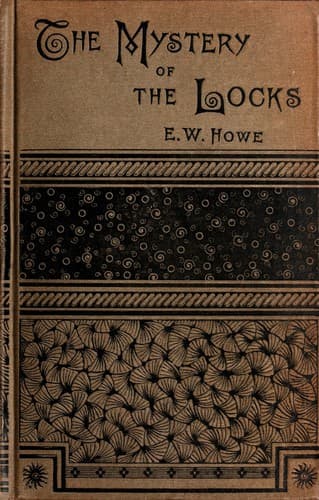
The Mystery of the LocksHowe, E. W. (Edgar Watson)
General
The Mystery of the Locks
Howe, E. W. (Edgar Watson)
City and town life -- Fiction; Man-woman relationships -- Fiction; Mystery fiction; Nebraska -- Fiction
He saw her look around, as if to convince herself that he was gone, when
the music changed from joy to regret while her face was yet turned
toward the door at which he had departed. She was thinking, and
expressing her thoughts with the pipes, and Allan Dorris knew what she
was thinking as well as if she were speaking the words. There were
occasional passages in the music so fierce and wild that he knew the
girl was struggling with desperate thoughts; nor could she easily get
rid of them, for the reckless tones seemed to be fighting for mastery
over the gentler ones. The old baritone air again; but strong and
courageous now, instead of mournful, and it seemed to be muttering that
it had ceased to be forbearing, and had no respect for customs, or
usages, or matters of conscience; indeed, there was a certain reckless
abandon in it which caused the listener to compare it to the roaring
song of a man reeling home to squalor and poverty--a sort of declaration
that he liked squalor and poverty better than anything else. The mild
notes of the accompaniment with the right hand--how like entreating
human voices they sounded--a chord of self-respect, of love of home, of
duty, in all their persuasive changes, urging the enraged baritone air
to be reasonable, and return to the pacific state which it had honored
so long; but the baritone air continued to threaten to break over all
restraint, and become as wild and fierce as it sounded. Occasionally the
chord of self respect, of love of home, and of duty, seemed to gain the
mastery, but the wicked baritone broke away again, though it was growing
more mild and tractable, and Allan Dorris thought that it must finally
succumb to the eloquent appeal in the treble. "I have been mild and
gentle all my life"--it seemed to be grumbling the words, as an apology
for giving in, instead of declaring them as an excuse for breaking over
all restraint--"and what good has it done me? Am I happier than those
who have mingled joys with their regrets? My mild sacrifices have
resulted in nothing, and I am tempted to try what a little spirit will
do."
But the unruly spirit was pacified at last, and the music resolved
itself into a lullaby of the kind which mothers sing to their children;
it may have been a recollection of the player's own childhood, for it
soon caused her to bow her head on the keyboard, and burst into tears.
CHAPTER XIV.
THE ANCIENT MAIDEN.
Jane Benton, old Thompson's maiden sister, was as good as anybody,
though no one urged the point as steadily as she did herself. Had the
President walked into Jane Benton's presence, she would have believed
that he had heard of her (although there was no reason that she should
entertain that opinion) and had called to pay his respects; and instead
of being timid in so great a presence, she would have expected him to be
timid in hers.
Public-domain text, read in full here on John Shaqi.
Reviews
Reviews
No reviews yet
Be the first to share your thoughts on this work.
Elsewhere in the archive
Join the Discussion
Join the discussion
Sign in to leave a comment or review.
Sign InorCreate an account