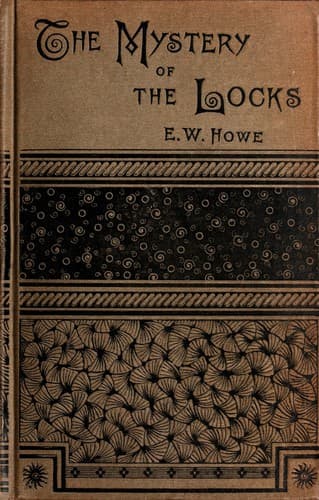
The Mystery of the LocksHowe, E. W. (Edgar Watson)
General
The Mystery of the Locks
Howe, E. W. (Edgar Watson)
City and town life -- Fiction; Man-woman relationships -- Fiction; Mystery fiction; Nebraska -- Fiction
"I imagine I have been rather satisfactory to your father," she said,
"but had I been his wife I doubt if we would have got along so well. A
man who is rather a good fellow is often very mean to his wife; and it
seems to be natural, too, for he does not admit it to himself, and
thinks he has justification for his course. I don't know what the
trouble is, but I know that the most bitter hatreds in the world are
those between married people who do not get along. Since you are so
curious about matrimony, I'll try and give you enough of it. Even a man
who loves his wife will do unjust things toward her which he would not
do to a sister he was fond of; and there is something about marriage
which affects men and women as nothing else will. There are thousands of
good husbands, but if you could see way down to the bottom of men's
wicked hearts not one in ten would say he was glad he had married.
That's a mean enough thing to say about the women, I hope, and if you do
not understand what my real preferences in your case are, you must be
blind."
Thompson Benton came in soon after, and they spent a very quiet evening
together. Annie retired to her own room early, and when she came to bid
her father good-night, tears started in her eyes.
"What is the matter with the girl?" he asked his sister after Annie had
disappeared.
Jane Benton did not reply for a long time, keeping her eyes on the pages
of a book she held in her hand, but at last she said,--
"I don't know."
Thompson Benton must have noticed that his sister was nervous, and had
he followed her up the stairs when she retired for the night, he must
have marvelled that she went into Annie's room, and kissed her over and
over, and then went hurriedly away.
CHAPTER XV.
A SHOT AT THE SHADOW.
The regular patronage of the "Apron and Password," like the attendance
at a theatre when reported by a friendly critic, was small, but
exceedingly respectable.
A gentleman of uncertain age who answered to the name of Ponsonboy, and
who professed to be a lawyer, usually occupied the head of the one long
table which staggered on its feet in the dingy dining-room, and when his
place was taken by a stranger, which happened innocently enough
occasionally, Ponsonboy frowned so desperately that his companions were
oppressed with the fear that they would be called upon to testify
against him in court for violence.
The minister, who occupied the seat next to Ponsonboy, and who was of
uncertain age himself, could demonstrate to a certainty that the legal
boarder was at least forty-five, but the legal boarder nevertheless had
a great deal to say about the necessity which seemed to exist for the
young men to take hold, and rescue Davy's Bend from the reign of "the
fossils," a term which was applied to most of the citizens of the town
after the other epithets had been exhausted, and as but few of them knew
what a fossil was, they hoped it was very bad, and used it a great deal.
Public-domain text, read in full here on John Shaqi.
Reviews
Reviews
No reviews yet
Be the first to share your thoughts on this work.
Elsewhere in the archive
Join the Discussion
Join the discussion
Sign in to leave a comment or review.
Sign InorCreate an account