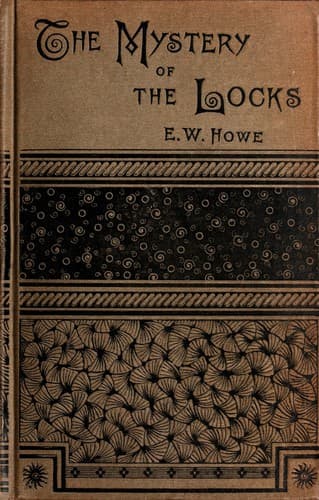
The Mystery of the LocksHowe, E. W. (Edgar Watson)
General
The Mystery of the Locks
Howe, E. W. (Edgar Watson)
City and town life -- Fiction; Man-woman relationships -- Fiction; Mystery fiction; Nebraska -- Fiction
"_Did_ he, though?" Tug impudently inquired. "Well, I'll give him half
if he'll prove it, for I need the money. Uncle Albert hears what is said
about me, and I hear what is said about him. If he'll make a date with
me, I'll exchange stories with him; and he won't have any of the best of
it, either. The people sometimes talk about as good a man as I am, and
even were I without faults, there are plenty of liars to invent stories,
so you can imagine that they give it to Uncle Albert tolerable lively."
Tug did not mingle with the people a great deal, but he knew about what
they were saying, and when talking to Silas he did not hesitate to quote
them to substantiate any position he saw fit to take. He had a habit of
putting on his hat on these occasions, and inviting Silas to accompany
him out in the town to see the principal people, in order that they
might own to what Tug had credited them with saying. But Silas always
refused to go, not doubting that his friend's inventions were true, so
it happened that Tug made out rather strong cases against his enemies.
"I can stand up with the most of them," he said, with an ill humor to
which hunger lent a zest; "and them that beat me, I can disgrace with
their poor relations. Show me the man that can't be beat if you go at
him right, and you may hang me with a thread. Them that are well-behaved
have shiftless relations, and I'll get them drunk, and cause them to
hurrah for 'Uncle Bill,' or 'Aunt Samantha,' or whoever it may be, in
front of their fine houses. I pride myself on my meanness, and I'll not
be tromped on. Let him that is without sin cast the first stone, and
I'll not be stoned. You can bet on that, if you want to."
Tug proceeded with his meal in silence until Silas said to him that
Reverend Wilton was a good man. Silas had a habit of inducing Tug to
abuse his enemies by praising them, and the ruse never failed.
"Well, don't he get paid for being good?" Tug replied, waving a kitchen
fork in the air like a dagger. "Ain't that his business? It's no more to
his credit to say that he is good, than to say that Silas Davy is a
hotel Handy Andy. If you say that he knows a good deal about books, I
will say, so does Hearty Hampton know a good deal about mending shoes,
for it's his trade. Shut Hearty up in a room, and pay him to post
himself regarding certain old characters he cares nothing about, and pay
him well, and in the course of years he will be able to speak of people,
events, and words which you, having been busy all the time, will know
nothing about. He ought to be good; it's his business. I always know
what a preacher is going to say when he opens his mouth, for don't I
know what he's hired to say? I don't like good men, any way, but a man
who is paid to be good, and expects me to admire him for it, will
find--well, I'll not do it, that's all. How's the old lady?"
Public-domain text, read in full here on John Shaqi.
Reviews
Reviews
No reviews yet
Be the first to share your thoughts on this work.
Elsewhere in the archive
Join the Discussion
Join the discussion
Sign in to leave a comment or review.
Sign InorCreate an account