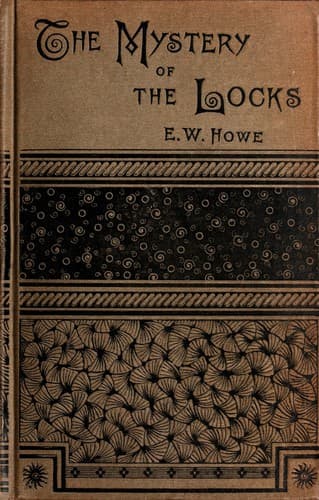
The Mystery of the LocksHowe, E. W. (Edgar Watson)
General
The Mystery of the Locks
Howe, E. W. (Edgar Watson)
City and town life -- Fiction; Man-woman relationships -- Fiction; Mystery fiction; Nebraska -- Fiction
"Because you are not like other women, who act by rule, and are nearly
all alike, is the reason I have no greater ambition than to be tied to
your apron-strings," he said. "I think your freshness and originality
are your greatest charms."
"Long before I ever thought of becoming a wife myself," she said,
seriously again, "I noticed that most men seemed to lack a knowledge of
women; that they regarded them as angels while they were girls, and were
disappointed because they turned out to be women as wives. I am not
unjust, but I have thought the women were partly responsible for this,
since many of them exhibit themselves like dolls, and pretend to be more
than they are. This is the reason why I am pleased that you are not
disappointed in me."
"As to your being an angel," he laughingly replied, "I know you are not
one, and I am glad of it. I have an idea that an angel would soon tire
of me, and fly away in disgust, to warn its companions that men were not
worth saving. There are some women so amiable that no matter to what
extent their affairs go wrong, they cannot muster up enough energetic
regret to cause them to supply a remedy. I am not so fond of amiability
as to desire it at that price. Whenever you find capacity you will find
temper, and I imagine that it would be dangerous to stir you up, for you
are as capable a woman as ever I knew. _Haven't_ you temper?"
"Plenty of it; too much," she answered.
They both laughed at this frank confession, and Dorris took occasion to
say that there was not a spark of it in his nature, though there was
temper written in every line of his countenance, and that he would have
been an ugly man when once fully aroused was certain.
They walked on again, and the shadow followed, as if anxious to hear
what they were saying.
"I can't account for it myself," Dorris continued, "but I enjoy your
company as much now as I did before we were married. It does me as much
good to talk love to you; I suppose it must be because you deserve it.
The fact that you are as careful to look well as you ever did may have
something to do with it, but it is certainly the case. I have heard men
abused a great deal for neglecting their wives after marriage, but it
never occurs to me to neglect you. I don't want to neglect you; I think
too much of you. If I should fail to be as considerate of you as you are
of me, I know that I would no longer receive the full measure of your
confidence and love, which is such a comfort to me, therefore it is my
first ambition to be just and honest with you in everything. The
ambition affords me a great deal of pleasure, too, for I am never so
well satisfied as when in your company. With you by my side, there is
nothing else that I crave in this world or the next."
"O Allan! Nothing in the next?"
They had seated themselves on a rough seat in a sort of park on the
hillside, and Dorris considered the matter.
Public-domain text, read in full here on John Shaqi.
Reviews
Reviews
No reviews yet
Be the first to share your thoughts on this work.
Elsewhere in the archive
Join the Discussion
Join the discussion
Sign in to leave a comment or review.
Sign InorCreate an account