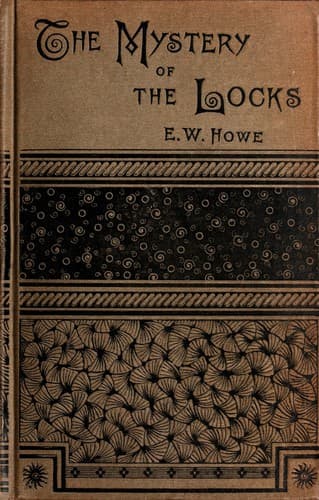
The Mystery of the LocksHowe, E. W. (Edgar Watson)
General
The Mystery of the Locks
Howe, E. W. (Edgar Watson)
City and town life -- Fiction; Man-woman relationships -- Fiction; Mystery fiction; Nebraska -- Fiction
"I am sure of that," his wife answered. "You always impress me as being
a fair man, and this was one reason why I forget myself in loving you. I
did not believe you would be unjust to anyone; surely not to one you
loved."
"I believe I am entitled to the compliment you pay me," he replied. "I
know myself so well that a compliment which I do not deserve does not
please me; but I deserve the good opinion you have just expressed. I
have known people whose inclinations were usually right; but mine were
usually wrong--either that, or I have been so situated that, by reason
of hasty conclusions, duty has always been a task; but notwithstanding
this I have always tried to be honest and fair in everything. It
sometimes happens that a man is so situated that if he would be just to
himself he must be unjust to others. I may have been in that situation,
and there may be those who believe that I have wronged them; but I am
sure that an honest judge would acquit me of blame. I have often wanted
to tell you my brief and unimportant history; but you have preferred not
to hear it. While I admire you for this exhibition of trust in me, I
have often wondered that your woman's curiosity did not covet the
secret."
"It is not a secret since you offer to tell it to me," she replied. "But
I prefer not to know it now. You once said to me that every life has its
sorrow; mine is the belief that I know what your history is; but I
prefer to hope that I am wrong rather than know my conjecture is right."
He looked at her with incredulity, and was about to inquire what she
knew, when she continued:
"You never speak to me that I do not get a scrap of your past history; I
read you as easily as I read a book. But I knew it when I became your
wife, and I think less of it now than ever; you are so kind to me that I
think I shall forget it altogether in time. It is scarcely a sorrow;
rather a regret, as I regret during my present happy life that I am
growing old. Sometimes I think I love you all the more because of your
misfortune, though I never think of it when I am with you; it is only
when I am alone that it occupies my mind."
"You are sure that you have not made it worse than it is?"
"Quite sure."
"Who was in the right?"
"You were."
"That much is true, anyway," he answered, looking out at the torrent in
the river, which the approaching daylight now made visible. "I formerly
had a habit of talking in my sleep; you may have learned something in
that way."
"A great deal," she replied. "I learned your name."
For the first time since she had known him he seemed confused, and there
was a flush of mortification in his face. He picked up a scrap of paper
and pencil which were lying on a table near them, and handing them to
her, said,--
"Write it."
Without the slightest hesitation, she wrote quickly on the paper, and
handed it back to him. He looked at it with a queer smile, tore up the
scrap, and said,--
Public-domain text, read in full here on John Shaqi.
Reviews
Reviews
No reviews yet
Be the first to share your thoughts on this work.
Elsewhere in the archive
Join the Discussion
Join the discussion
Sign in to leave a comment or review.
Sign InorCreate an account