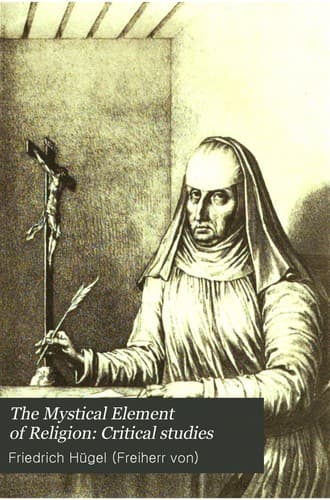
The Mystical Element of Religion, as studied in Saint Catherine of Genoa and her friends, Volume 2 (of 2)Hügel, Friedrich, Freiherr von
Religion
The Mystical Element of Religion, as studied in Saint Catherine of Genoa and her friends, Volume 2 (of 2)
Hügel, Friedrich, Freiherr von
Catherine, of Genoa, Saint, 1447-1510
Loda LXXXXVIII, “Of the Incarnation of the Divine Word,” full though
it is of beautiful Franciscanism, has left her uninfluenced. But the
fine Loda LXXXXIX, “How true Love is not idle,” contains touches which
have sunk deep into her mind. “Splendour that givest to all the world
its light, O Love Jesus … heaven and earth are by Thee; Thine action
resplends in all things and all things turn to Thee. Only the sinner
despises Thy Love and severs himself from Thee, his Creator,” v. 6,
is, in its substance, taken over by her. “O ye cold sinners!” v. 12,
is her favourite epithet. And vv. 13, 14, with their rapid ringing of
the changes on the different sense-perceptions, will, by their shifting
vividness, have helped on a similar iridescence in her own imagery: “O
Odour, that transcendest every sweetness! O living river of Delight …
that causest the very dead to return to their vigour! In heaven Thy
lovers possess Thine immense Sweetness, tasting there those savoury
morsels.”
And finally Loda LXXXVII, “Of true and false discretion,” which, in vv.
12-20, consists of a dialogue between “the Flesh” and “the Reason,”
will have helped to suggest the slight beginnings of this form of
apprehension to Catherine which we have found amongst her authentic
sayings and experiences, and which were, later on, developed on so
large a scale, by Battista Vernazza, throughout her long _Dialogo della
Beata Caterina_.
5. Jacopone it is, then, who furnished Catherine with much help towards
that rare combination of deep feeling with severely abstract thinking
which, if at times it somewhat strains and wearies us moderns who would
ever end with the concrete, gives a nobly virile, bracing note to even
the most effective of her sayings.
V. POINTS COMMON TO ALL FIVE MINDS; AND CATHERINE’S MAIN DIFFERENCE
FROM HER FOUR PREDECESSORS.
If we now consider for a moment the general points common to the four
writers just considered and to Catherine, we readily note that all
five are profoundly reflective and interpretative in their attitude
towards the given contingencies of traditional religion; that they
all tend to find the Then and There of History still at work, in
various degrees, Here and Now, throughout Time and Space, and in the
last resort, above and behind both these categories, in a spaceless,
timeless Present. And if only three, Paul, Jacopone, and Catherine,
bear marks, throughout all they think and feel and do and are, of the
cataclysmic conversion-crisis through which they had passed,--the
temporally intermediate two, John and Dionysius, have also got, but in
a more indirect form, much of a similar Dualism. All five are, in these
and other respects, indefinitely closer to each other than any one of
them is to the still richer, more complete, and more entirely balanced
though less articulated, Synoptic teaching, which enfolds all that
is abiding in those other five, whilst they, even if united, do not
approximately exhaust the substance of that teaching.
Public-domain text, read in full here on John Shaqi.
Reviews
Reviews
No reviews yet
Be the first to share your thoughts on this work.
Elsewhere in the archive
Join the Discussion
Join the discussion
Sign in to leave a comment or review.
Sign InorCreate an account