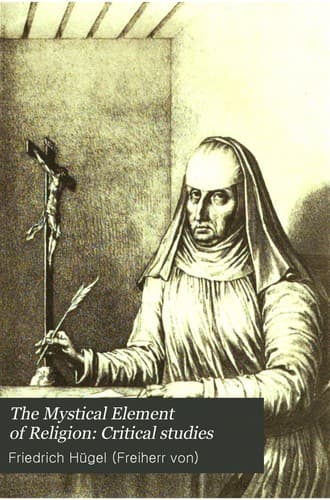
The Mystical Element of Religion, as studied in Saint Catherine of Genoa and her friends, Volume 2 (of 2)Hügel, Friedrich, Freiherr von
Religion
The Mystical Element of Religion, as studied in Saint Catherine of Genoa and her friends, Volume 2 (of 2)
Hügel, Friedrich, Freiherr von
Catherine, of Genoa, Saint, 1447-1510
(2) The fact is that here, as practically at every chief turning-point
in ethical and religious philosophy, the movement of the specifically
Christian life and conviction is not a circle round a single
centre,--detachment; but an ellipse round two centres,--detachment and
attachment. And precisely in this difficult, but immensely fruitful,
oscillation and rhythm between, as it were, the two poles of the
spiritual life; in this fleeing and seeking, in the recollection back
and away from the visible (so as to allay the dust and fever of growing
distraction, and to reharmonize the soul and its new gains according
to the intrinsic requirements and ideals of the spirit), and in the
subsequent, renewed immersion in the visible, (in view both of gaining
fresh concrete stimulation and content for the spiritual life, and of
gradually shaping and permeating the visible according to and with
spiritual ends and forces): in this combination, and not in either
of these two movements taken alone, consists the completeness and
culmination of Christianity.[120]
(3) It no doubt looks, at first sight, as though the Church, by her
canonization of the Monastic Ideal, gave us, for the ultimate pattern
and measure of all Christian perfection, as pure and simple a flight of
the soul from the body and the world, as (short of insanity or suicide)
can be made in this life. But here we have to remember three things.
In the first place, the Church not only forbids all attacks upon
the legitimacy, indeed sanctity of marriage, or upon its necessity,
indeed duty, for mankind at large; but St. Augustine and St. Thomas
only articulate her ordinary, strenuously anti-Manichean teaching,
in declaring that man was originally created by God, in body and in
soul, not for celibacy but for marriage; and that only owing to the
accidental event of the Fall and of its effects,--the introduction of
disorder and excess into human nature, but not any corruption of its
substance and foundations,--does any inferiority,--the dispositions,
motives, and circumstances being equal,--attach to marriage as compared
with virginity.[121] Hence, still, the absolute ideal would be that man
could and did use marriage as all other legitimate functions and things
of sense, as a necessary, and ever more and more perfected, means and
expression of truly human spirituality, a spirituality which ever
requires some non-spiritual material in which to work, and by working
in which the soul itself, not only spiritualizes it, but increasingly
develops its own self.
Public-domain text, read in full here on John Shaqi.
Reviews
Reviews
No reviews yet
Be the first to share your thoughts on this work.
Elsewhere in the archive
Join the Discussion
Join the discussion
Sign in to leave a comment or review.
Sign InorCreate an account