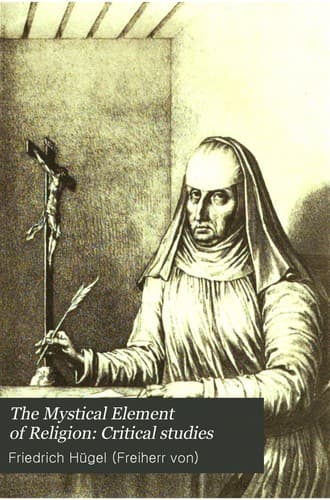
The Mystical Element of Religion, as studied in Saint Catherine of Genoa and her friends, Volume 2 (of 2)Hügel, Friedrich, Freiherr von
Religion
The Mystical Element of Religion, as studied in Saint Catherine of Genoa and her friends, Volume 2 (of 2)
Hügel, Friedrich, Freiherr von
Catherine, of Genoa, Saint, 1447-1510
This immense disproportion between the work and its reward, and the
consequent grace-character of the latter, is driven home with a
purposely paradoxical, provocative pointedness, in the two Parables of
the Wedding Garment and of the Equal Payment of the Unequal Labourers,
both of which are in St. Matthew alone. The former concerns the soul’s
call to the kingdom, and that soul’s response. The King here, after
having formally invited a certain select number of previously warned
relatives and nobles, who all, as such, had a _claim_ upon him, Matt,
xxii, 3, sends out invitations with absolute indiscrimination,--to men
with no claims or with less than none; to “bad” as well as “good.” And
it is the King, again, who gratuitously supplies them each with the
appropriate white wedding-feast garment. He has thus a double right to
expect all his guests to be thus clothed, and to punish instantly,
not the mere negligence, but the active rejection implied on the part
of the man clothed in his ordinary clothing (vv. 11, 12). Both call
and investiture have been here throughout pure graces, which rendered
possible, and which invited but did not force, an acceptance.[149]
The second Parable describes the “Householder” who hired labourers
for his vineyard at the first, third, sixth, ninth, and even eleventh
hour,--each and all of them for a penny a day; who actually pays out
to them, at the end of the day, this one identical pay; and who,
to the labourer of the first shift who complains, “These last have
wrought but one hour, and thou hast made them equal unto us who have
borne the burden and heat of the day,” declares, “Friend, I do thee
no wrong: didst thou not agree with me for a penny? Take thine own
and go thy way: I will give to this last even as unto thee. Is it not
lawful for me to do what I will with mine own? Is thine eye evil (art
thou envious) because I am good” (because I choose to be bountiful)?
Matt. xx, 1-15. Here again the overflowing generosity of God’s grace
is brought home to us, as operating according to other standards
than those of ordinary daily life: nor is this operation unjust, for
the Householder paid their due to the first set of workers, whilst
rewarding, far above their worth, those poor labourers of the last
hour. But, as Jülicher well points out, “we should not pedantically
insist upon finding here a doctrine of the strict equality of souls in
the Beyond--a doctrine contradicted by other declarations of Jesus.
Only the _claim_ of single groups of souls to preferential treatment is
combated here …: a certain fundamental religious disposition is to be
awakened.” And, as Bugge rightly notes, “the great supreme conception
which lies at the bottom of the parable has, parablewise, remained here
unnamed: Paul has found the expressive term for it,--‘Grace.’”[150]
Public-domain text, read in full here on John Shaqi.
Reviews
Reviews
No reviews yet
Be the first to share your thoughts on this work.
Elsewhere in the archive
Join the Discussion
Join the discussion
Sign in to leave a comment or review.
Sign InorCreate an account